Moving from the Big Picture to Teaching and Learning Practices

This week has seen us continuing our big picture thinking but also now starting to focus in on what that will look like in the classroom.

On Monday we had a team trip into town for a mystery day out. The ferry ride through the rising fog was a good metaphor for what we would be going through over the rest of the day.

After breakfast together we were split into 2 teams and given a map of checkpoints and clues to decipher. Basically it was a 2 hour adventure race around town finding the checkpoints and taking interpretive photos to represent what we found. The checkpoints all turned out to be pieces of art around town and afterwards we found out that it was actually the Auckland Waterfront Sculpture Tour. Our team then made this video to represent our interpretations of the sculptures:

After a quick bite to eat we then headed to New Zealand Trade and Enterprise for a Design Thinking workshop with Peter Harrison from the Better by Design team. Walking onto their floor we got a hint at what was coming by the large poster on the wall giving tips for creative conversations:
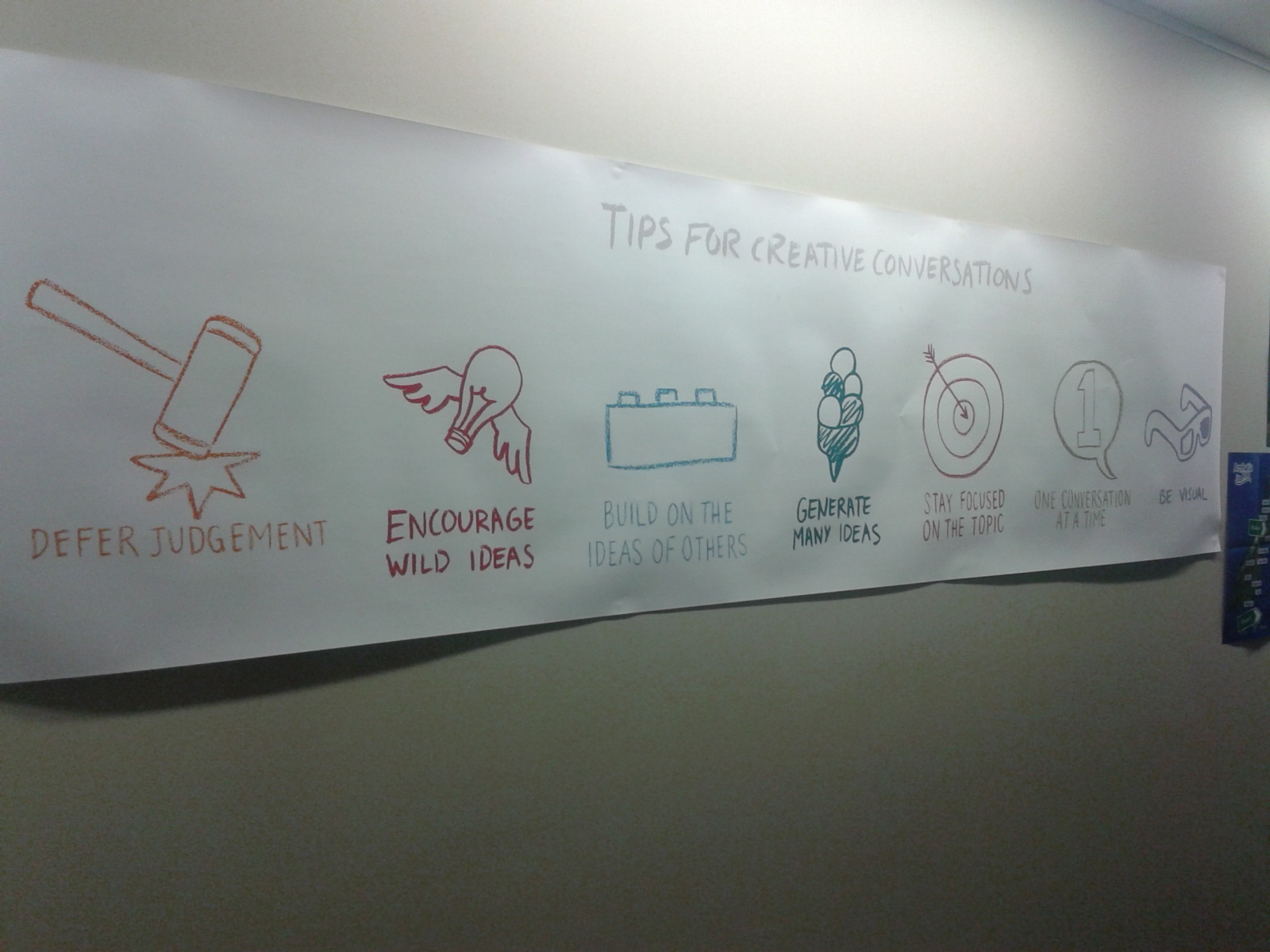
Tips for Creative Conversations

Tips for Creative Conversations

This was an awesome 2 hour workshop introducing us to the ideas of Design Thinking. Continue reading

Research Access Success

Two weeks ago, I sent an email to a group of people high up in the Ministry of Education and put it online in this post asking for access to academic journals as a teacher. I have had a range of conversations with people over the past 2 weeks about this and today had a successful outcome to the email.

The obvious message over the last 2 weeks has been that there are lots of teachers out there craving access to research so they can challenge and improve their practice. Everyone I have spoken to has been interested in what the outcome would be. Either because they also want more access to research themselves or because they see the value in it so much they are currently undertaking research or study and want to know where they can read once their study finishes. Continue reading

A Crumbling Capitalist Schooling System?

On June 13th I was lucky to attend John Morgan’s inaugural public lecture at the University of Auckland. It was entitled “Schooling the Crisis: Education in the aftermath of the financial crisis.”

John Morgan preparing for his lecture

John Morgan preparing for his lecture

What follows is a synopsis of John’s lecture with my reflections integrated into it.

For the last 3 decades schooling has been thought of as preparation for the real world. So far, the post financial crisis of the last 5 years has not made people question what needs to change in schooling. Yet we need to acknowledge that we are preparing students for uncertain futures.
Continue reading

Guide to Developing Good Questions

This question development guide was one first developed in a previous school which I have updated recently. The Word version of this is formatted nicely but this gives a good idea of how it works:

Brainstorm of your early ideas 

Questions/topics/areas/issues related to theme that you may be interested in developing further Continue reading

Great Competitions You May Not Have Heard Of

I have come across some great competitions for NZ students over the past couple of weeks and wondered how many new about them. All 3 of these provide great, engaging, provoking tasks that Im sure at least some of your students will love!

The Barbara Petchenik Childrens Mapping Competition is an international competition that occurs every 2 years. It aims to promote children’s creative representation of the world in graphic form, to enhance their cartographic awareness and to make them more conscious of their environment. There are 4 different age groups and the maps can be made in a wide range of forms. More info is available here.

The Eggs Prize Competition is being launched at the Makertorium in April at Te Papa. It is a team competition to design a machine that can transport an egg. Teams are open to create a machine using any technology they choose (barring explosives) be it simple or complex. As well as an overall judged “best machine” there will be awards, such as most humorous, fastest, best technically, most efficient and most eco friendly. See more on the Makertorium website here.

Mix and Mash is a chance for students to get creative mixing up creative commons digital content into new stories. It will teach digital citizenship skills as well as letting them get creative. I saw this 2 days ago and we have already worked the first round of it into our Year 10 accelerate Social Studies programme – it is that great! Read more at www.mixandmash.org.nz.

What other great unknown competitions are out there!?

The Complex Classroom

As the school year begins and students start coming back into class, I felt it was time for me to refresh the conditions necessary for my classes to operate as complex, living networks. This is a quote which I have loved since first reading it and it is something I strive to achieve:

In this context, the practitioner is less like the bulldozer driver carving a way through the landscape to a pre conceived objective, more like a combination of canoeist shooting the rapids and creative artist exploring possibilities and waiting for inspiration.

(Mike Radford, 2007) Continue reading

Points to Ponder from ICOT Wednesday & Thursday

Some statements and questions to reflect on from the breakouts I attended at ICOT on Wednesday and Thursday

Rose Hipkins

Embodied thinking is intuitive, ‘rational’ decisions are usually after-the-fact justifications
How do you develop students’ intuitive thinking?
Thinking in the spaces between individuals or ideas is a more apt metaphor for the changes afforded by information technologies
We need to push past our urge to stick with people like us. Learn to love difference – then you will learn
Epistemic experiences are moments when we become conscious of something about our knowing

Martin Renton – In the Learning Pit

Moving from clarity to confusion is a positive step in the learning process
No such thing as a bad question. The important part is the reason for asking the question
Get comfortable with silence, it helps us process our thinking
How often do you question to confuse your students

Hana Olds

Active thinking is where creative, critical and caring thinking overlap
Do your inquiries allow for passion, persistence and purpose?
“I don’t want a project, I want something with a purpose”

Rich Allen

Don’t just think differently, act differently
Good teachers are always learning from their students
Lesson plans are hallucinations

Karen Melhuish Spencer

Social networks privilege the individual, online communities privilege the relationship
Do you use social networks to check or challenge your thinking?
What social network has the most effective impact on your teaching? How? Can you prove this?
As educators we are morally obliged to share our practice for the good of all students