What is the Essence of Your School?

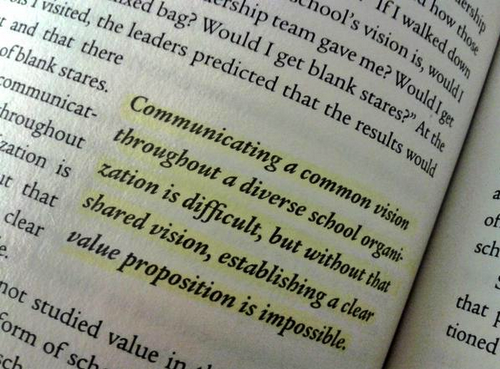
Thanks Jo for this image from #EdJourney by Grant Lichtman

Thanks Jo for this image from #EdJourney by Grant Lichtman

In #EdJourney, Grant Lichtman discusses schools’ value proposition. That is, what your school offers compared to other schools. Each school sets out their vision – implemented to different levels by different schools, some completely through all staff members, some just believed by Senior Leadership. The Value Proposition, as I understand it, is about what you actually do compared to what you say you will do (much like Espoused Theory vs Theory in Use by Chris Argyris). It essentially says that the practices of a school tells their community they really value. If we asked parents what their son or daughter gains by going to your school rather than the one down the road, this is the Value Proposition.

This reminded me of a challenge from Ewan McIntosh at the end of last year to capture the essence of what our school was all about in just 1 sentence. Continue reading
Hauora – a New Zealand Perspective on Wellbeing

My twitter feed lately has been full of tweets and blogs from the UK with the hashtag #teacher5aday. A movement started by Martyn Reah it is all about bringing teacher wellbeing to the forefront of people’s minds. His initial blogpost (along with Teach Meet presentations) that started the movement spoke about how teachers always worry about students wellbeing and then challenged teachers to look after themselves more under the headings of:

  • connect
  • exercise
  • notice
  • learn
  • volunteer

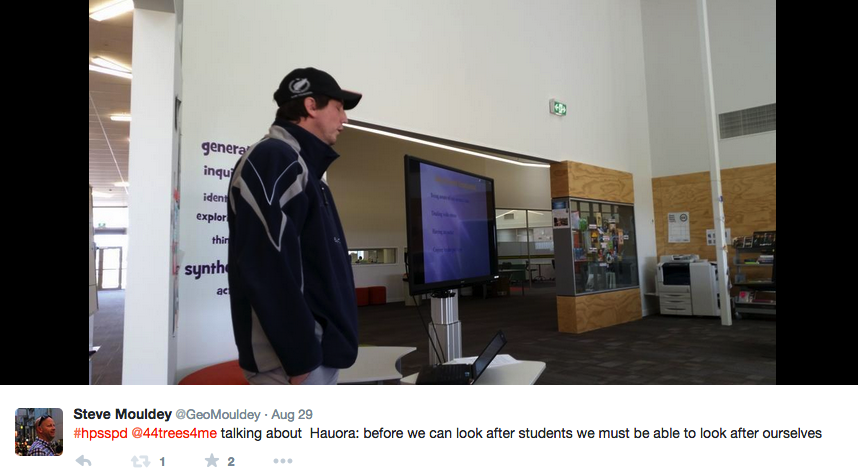
This reminded me of last year when my colleague Bryce challenged Hobsonville Point Secondary School staff on our wellbeing in an Ignite talk during Staff PD.

Snip20150208_36


In New Zealand we tend to use the Maori perspective on wellbeing – Hauora. Continue reading

Powerful Partnerships in Action

Our school has the phrase “powerful partnerships” in it’s mission statement and to me this is the aspect of our school that sets us apart as quite different from other Secondary Schools in our area.

We (aim/try to/do) live out these powerful partnerships in:

  • Learning Hubs – partnerships between Hub coach, student and parents to support each student to pursue their vision of academic and personal excellence
  • Learning Modules – partnerships between learning areas to enable connected, more powerful learning for our students (as detailed in yesterday’s post)
  • Big Projects – partnerships between our students and local community to pursue PBL opportunities

Today was a great example of Powerful Partnerships. We held our 2nd annual Waitangi Celebration Day. Students from Hobsonville Point Secondary School combined with Hobsonville Point Primary School to learn together for the day in 90 minute workshops run by teachers, students or community members. Truly living out the Partnership Principle of the Treaty of Waitangi. Continue reading

Constraints Causing Creativity

I first came across the idea of enabling constraints when investigating Complexity Theory for my thesis. The book Engaging Minds gives great examples of how the right level of constraints are required to truly cause creativity to occur. This was echoed recently in a post by Tom Barrett in his post about setting the right level of constraint for learning in your class.

As this school year started, Hobsonville Point Secondary School was entering it’s 2nd year of operation and that brings new levels of constraints. 2 Year levels to plan for so double the students and some (nowhere near double) new staff on board. So, how to evolve our structures.

First of all, the 3rd generation timetable:

Snip20150204_22

Specialised Learning Modules are co-taught by 2 teachers and last year had 2 teaching blocks, we wanted to deepen this so worked a way for each to have an extra hour this year. We also wanted to leverage teacher-student relationships more to enable learning so students will stay with the same teachers for a semester (2 terms) even though the focus concepts shift in the 2nd term from Culture and Diversity to Relationships. Continue reading

Getting to Know My Learners

Day 2 of #28DaysofWriting and it was Day 1 of school for the year. That meant that today was spent with the 12 Year 9 and 10 students in my Learning Hub (our HPSS version of Learning Advisories). Part of the day focused on getting to know each other and part of the day on a challenge introducing them to one of our Hobsonville Habits.

I have 2 aims in the first few days of school every year:

  1. Get to know my learners
  2. See them go home happy

Today I got to know my Hub through a range of activities involving them speaking to each other, writing answers, drawing pictures and creating sculptures out of material such as play doh, paper, straws and pipe cleaners. I also learned a lot (possibly more) by watching how each of them approached each activity. Continue reading

2015 Was A Great Year

Creative Commons image sourced from: http://pixabay.com/en/sylvester-2015-fireworks-435376/

Creative Commons image sourced from: http://pixabay.com/en/sylvester-2015-fireworks-435376/

An ex-Principal of mine (Prue Kelly at Wellington High School) used to start the 1st Teacher Only Day of the year saying that it had been a great year. By setting that expectation from the start we just had the ‘simple’ task of proving her right. I am facing a year looking completely full of awesome (yes in the true sense of the word: reverence, fear et al) challenges: Continue reading

Working in an MLE

This post was originally written for The Network – a newsletter for the New Zealand Board of Geography Teachers:

Modern Learning Environments (MLE) seem to be springing up all over the country and all new builds or developments in schools now are supposed to be under this model. I have been teaching in a brand new MLE this year at Hobsonville Point Secondary School. So what is it actually like to work in an MLE? Continue reading

Refining to a Focus

It’s that time of term where students have been really using their knowledge to develop deeper understandings. For the modules I teach, the last 2 weeks have been full on action time generating possible actions/solutions/products, refining them down and taking action.

Under the d.School Design Thinking process this would be the Ideate and Prototype stages; those using DEEP Design Thinking would know it as Experiment and Produce. For us at Hobsonville Point we use the language from our Learning Design Model below:

HPSS Learning Design Model

HPSS Learning Design Model

So, the last 2 weeks have seen us talking about Generate, Refine, Focus and Test. Continue reading

Iterating Forward

This post is to share a few iterations happening at Hobsonville Point Secondary School. I wrote last week about the process we were undertaking to evaluate and adjust our timetable for Term 4. We have now created the next iteration of our timetable. This sits alongside the new iteration of our Learning Design Model that occurred earlier this term and the next iteration of how my Learning Hub will operate. Continue reading

An Awesome Day of Design Thinking

Tuesday proved to me just how much Design Thinking is the way I approach all aspects of school (and increasingly life) these days. In reflecting on what had happened this week I realised that Tuesday was an entire day of Design Thinking.

I started the day with my Hub completing the redesign of our space. Last week I had realised that things needed to improve with my Hub teaching so we had completed a SWOT analysis of our Hub and everyone had drawn how they would design our space to make it work for us. It was pretty clear from all the pictures that a common theme had emerged. So, away went our old space:

20140826_085646

And in came our new design:

20140904_080757

We have still kept the seating we like for Hub time – mainly ottomans and a few beanbags. But now we have got rid of any other form of seating, created a break out area and swapped the unused table that was a dumping ground for a low table that we can work on from our low seats. Early days but it has definitely created a better feel for us as a group.

After this was finished we Continue reading