Unknown's avatar

About stevemouldey

Geographer, Educator, Pontificator

Getting Strategic With Goals

“That was great. I have never thought that deeply about my goals before.”

Hearing this from a normally quite cynical Year 10 boy was a great end to a session I ran yesterday. Our Taheretikitiki community is focusing on the Hobsonville Habit of Purposeful this week and it was my turn to run the community activity. Being early in the year, many of the Hubs have been developing goals for the year so the focus of the session was to develop strategies that would help them reach their goals.
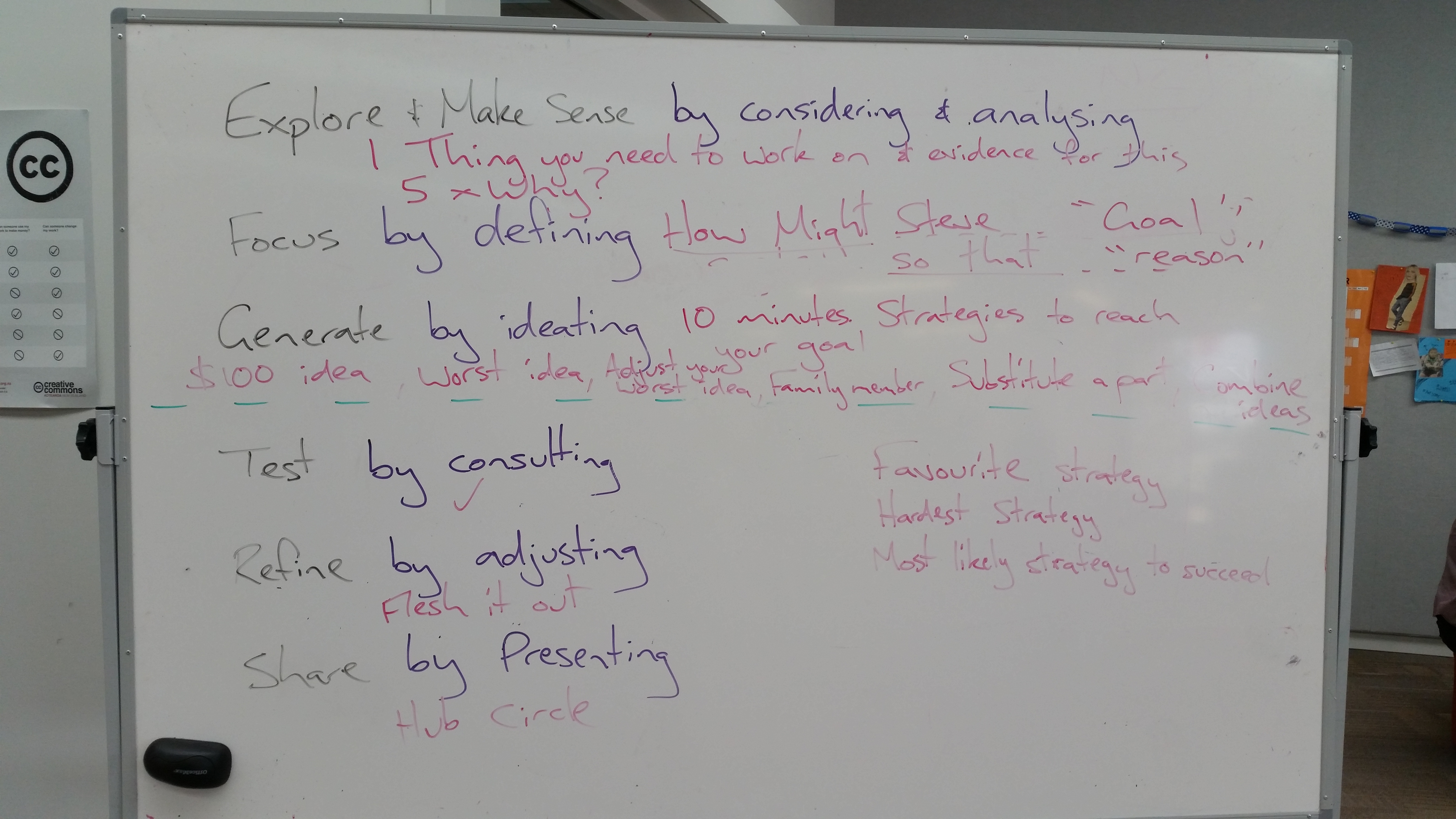
Whiteboard notes that will make sense if you keep reading!

Whiteboard notes that will make sense if you keep reading!

The image above is the whiteboard notes from our Goal session and show the steps that we went through. The steps above the green line happened as a whole community (~79 students) and the last 3 steps were back in their hubs (groups of 11-12). Continue reading

What if PPTA does boycott EDUCANZ?

With legislation passed, it is now full steam ahead for EDUCANZ to replace the New Zealand Teachers Council. In response to this, the Post Primary Teachers Association (PPTA) is proposing a boycott of EDUCANZ and has asked all branches to run a ballot on this idea.

Why boycott? It is a flawed legislation. Teachers can no longer vote for representation on their own professional body, the aspirational code of ethics is being replaced with a patronising code of conduct and has a major focus on auditing teacher appraisal processes. Although, to be honest, I do see the positive side of auditing appraisal processes as well – how many of these are actually being done as a tick box affair as compared to operating in a way that helps us improve as professionals? Still a boycott would aim to build public pressure to force changes to the legislation.

We will still, however, all have to pay EDUCANZ to renew our teacher registration (and early signs are that fees will rise quite a bit) as it is illegal for us to be in the classroom without this. So effectively, if we boycott EDUCANZ we will give them money to complete their aims but remove any possibility of our voice having an influence in what that aim looks like in practice. Continue reading

MLP not MLE

This week I have been in Christchurch as part of our efellows programme. Our time was split between working on our research; provocations from Core staff such as Keryn Davis  (on power of play and student questions) and Derek Wenmoth (returning to the why and sharing books that are at the core of his beliefs to get us thinking of our core beliefs); and getting the chance to visit some schools in the area.

The schools that we were privileged to visit were Breens Intermediate and Te Pa o Rakaihautu. There were 2 really key points that I took from these visits: 1) seeing what it looks like when a shared vision is in action and 2) what MLE can look like in traditional classrooms. What they showed together was that modern learning environments is a complete misnomer, it is about modern learning practices. Continue reading

Reconstruction of Christchurch

I’m a Geography teacher. I have spent the last dozen years teaching students about natural disasters. Teaching them that disasters are not just one off events, that a major part of understanding a disaster is the reconstruction afterwards. Yet, today I was shocked by what I saw in Christchurch.

I like to think I am fairly on top of what is happening in the world currently. I constantly read news online, I scour social media for any storied that might be relevant for our learners. Heck, I’m even connected online with plenty of people that live in Christchurch. My in-laws were involved in the Quake. Injured, lost belongings but realistically lucky compared to many others. They have told me that I don’t understand what it was really like. Today I know that is the truth. Continue reading

Transformation and Discomfort

There is a lot of talk about transforming education or transforming schools these days. Many of the ideas or initiatives linked with this though leave me wondering whether we really understand the challenge we face to transform education in New Zealand. Many of the initiatives I have discussed with others lately are based around STEM and/or digital technologies, so that will be the slant of this post. All of these initiatives are truly innovative and are having great outcomes for students and teachers, but I wonder is it enough and are they focused on the right things?

In our experience here forming Hobsonville Point Secondary School, the hardest thing about change is the discomfort that occurs. This was also backed up in EdJourney where Grant Lichtman says that change is not hard, change is uncomfortable. To me, none of the innovations and initiatives trying to bring about change are really addressing this discomfort well. Continue reading

Empowering Learners Through Common Language

It’s hard but that’s okay because you keep trying and then it becomes easier and then it becomes fun. That’s how you learn.

This cool little quote is from my 5 year old daughter after ballet practice yesterday. Apart from the glaringly obvious growth mindset that she has at the moment, it made me start thinking about how my students would describe how they learn.

At HPSS we have our Learning Design Model that was developed out of our deep exploration of the New Zealand Curriculum. This is the language that we use to describe how learning occurs.

HPSS Learning Design Model

HPSS Learning Design Model

We envision learning as cyclical (not circular otherwise you go nowhere – in Di Cavallo‘s words!) rather than linear. Continue reading

An Alphabet of Inspiration

One of the great points I got out of Steal Like an Artist by Austin Kleon was that of your creative genealogy. Who are the people that inspire you, whose ideas have added to your creativity; whose ideas can be seen remixed in the work that you do?

So here is my attempt at a creative genealogy in the form of an A-Z of people inspiring me on twitter lately (with some tired Friday night liberties taken on how it works): Continue reading

Why inquire into Design Thinking for my eFellowship?

This year I am part of Core Education’s eFellowship program. The purpose of this scholarship is to “inspire transformational practice through inquiry.” For my inquiry I am looking to explore Design Thinking which, for those who read my blog or follow me on twitter, is something that I have been passionately using lately. This year for me is a chance to put a critical eye on its use.

At our first meeting of the year in late January, we got to explore the purpose of our inquiry and here is what I managed to generate:

20150219_141948

Through reflection on this, more reading and a skype session with Louise Taylor who is in charge of our research from Core Education, I have put together the following plan for my inquiry: Continue reading

My Advice for BTs

wpid-screenshot_2015-02-18-16-09-58.png

Comic from XKCD

As we kick into gear of a new school year here in New Zealand, I often reflect back on what it was like starting off in those first couple of years of teaching. If there is one lesson, one piece of advice I would give to any Beginning Teacher to help them survive and ultimately thrive, it is this:

Get to know the people that really run the school. The receptionists, student services, grounds staff, the IT and other technicians, the Principal’s PA, the tea lady, Librarians etc.

These people are the oft-forgotten glue that hold a school together. If you can get onside with them, your job will become much, much easier. Continue reading

Student Echo Chambers

Yesterday I wrote about breaking out of my echo chamber, so of course my thoughts then turned to my students. Are our students operating in echo chambers and should this be something we worry about?

Well yes, I believe this is something to be concerned about and here’s why. Deeper understanding is developed through:

  • encountering multiple perspectives
  • confronting cognitive dissonance
  • empathising with situations different to our own

If students are constantly interacting with people with similar opinions to themselves, how are they going to do any of the above? Continue reading