Shattering the Echo Chamber

For some time I have spoken about the value of reaching outside your echo chamber to ensure you keep growing. At Hobsonville Point Secondary School we have been living in a privileged bubble with unheard of resources of time and space as we got started. Claire Amos realised the danger of only listening to those with similar views early on and kept making a point for us to keep challenging ourselves.

I regularly try to read blogs and books that will push my thinking forward and have tried to break out of the educational echo chamber that is my online and face to face PLN. What this weekend has just proven to me, however, is that I have merely dipped out of my echo chamber every now and then.

This weekend, I completely shattered my echo chamber. Kiwi Foo is an invite only unconference of people from across many different fields and sectors. From Friday evening through to Sunday afternoon I was with over 150 of the most intelligent people I have ever met. The workshops ranged from specific topics such as Conspiracy Theories of Aotearoa (you really should follow Matthew Dentith) to wider ideas such as how to make the most of conferences or if NZ had an aim, what would it be? These workshops stretched my brain but it was the discussions in between that completely blew my brain.

CC image from Prairie Kittin that matches my brain at Kiwi Foo

CC image from Prairie Kittin that matches my brain at Kiwi Foo

Discussing:

  • Design Thinking with Start Up investors, major corporates and social change innovators;
  • education with Researchers that I have read for years, Principals and teachers that I have either connected with online or not ever met before, engineers, bankers, scientists and entrepreneurs;
  • ethics with journalists, professors and social enterprise experts
  • meaningful societal change with politicians, designers, web developers, festival organisers and entrepreneurs

meant that my brain was pushed incredibly hard and it is taking me a few days to really process what happened over the weekend. To those who I chatted with, made quasi-plans with, ate next to, swam with or played Werewolf with: Thank You!

To Nat and Jenine that make the incredible world of Kiwi Foo occur, thank you for truly shattering my echo chamber. I will not be going back to a mere dabble in outside ideas. I am now going to be actively seeking voices from within education that challenge my ideas and many, many voices from outside education to see what we can learn from each other.

p.s. written in 28 minutes for #28daysofwriting so excuse my still mind fuddled ramble
What is the Essence of Your School?

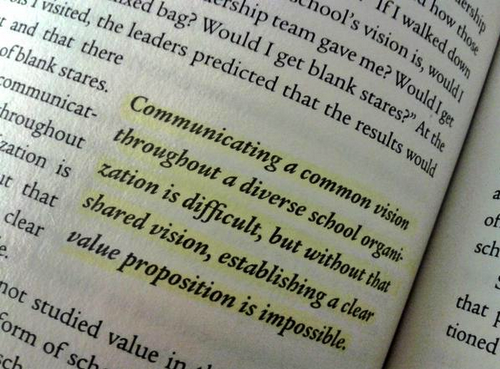
Thanks Jo for this image from #EdJourney by Grant Lichtman

Thanks Jo for this image from #EdJourney by Grant Lichtman

In #EdJourney, Grant Lichtman discusses schools’ value proposition. That is, what your school offers compared to other schools. Each school sets out their vision – implemented to different levels by different schools, some completely through all staff members, some just believed by Senior Leadership. The Value Proposition, as I understand it, is about what you actually do compared to what you say you will do (much like Espoused Theory vs Theory in Use by Chris Argyris). It essentially says that the practices of a school tells their community they really value. If we asked parents what their son or daughter gains by going to your school rather than the one down the road, this is the Value Proposition.

This reminded me of a challenge from Ewan McIntosh at the end of last year to capture the essence of what our school was all about in just 1 sentence. Continue reading

Natural Ecosystem of Learning

Schools that recognize the need to prepare their students for a changing world are knowingly or unknowingly in the process of converting from an engineered process to a model based on the laws that govern natural ecosystems

Grant Lichtman, #EdJourney p210

In #EdJourney, Grant Lichtman makes the link between schools that are effectively innovating and how natural ecosystems operate. He found that the schools demonstrating transformative learning were:

  • more dynamic – moving far away from one size fits all
  • more adaptable – functioning like outside world and adaptable to future change
  • more permeable – expanding learning beyond the four walls
  • more creative – moving past consumption of knowledge
  • self-correcting – based upon empathy, mindfulness and creativity

Using this, Grant proposes a model that shifts from Assembly-Line Education to a Learning Ecosystem. Continue reading

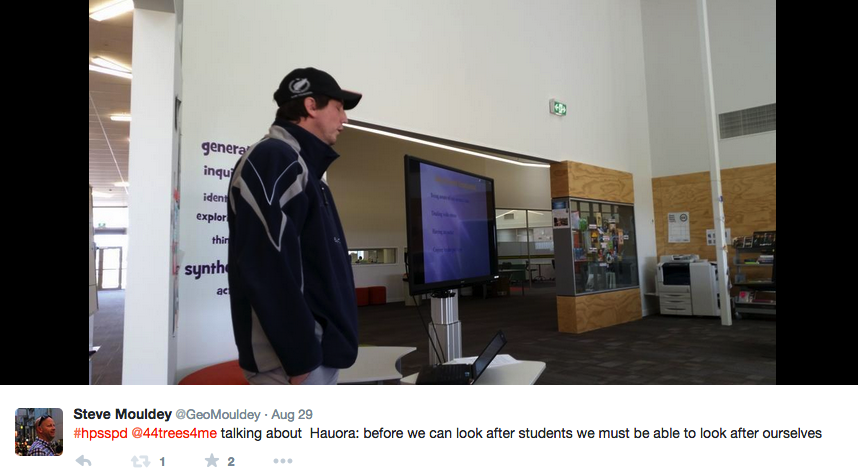
Hauora – a New Zealand Perspective on Wellbeing

My twitter feed lately has been full of tweets and blogs from the UK with the hashtag #teacher5aday. A movement started by Martyn Reah it is all about bringing teacher wellbeing to the forefront of people’s minds. His initial blogpost (along with Teach Meet presentations) that started the movement spoke about how teachers always worry about students wellbeing and then challenged teachers to look after themselves more under the headings of:

  • connect
  • exercise
  • notice
  • learn
  • volunteer

This reminded me of last year when my colleague Bryce challenged Hobsonville Point Secondary School staff on our wellbeing in an Ignite talk during Staff PD.

Snip20150208_36


In New Zealand we tend to use the Maori perspective on wellbeing – Hauora. Continue reading

Ungoogleable Questions Update

By far and away my most read post on this 2 year old blog is a post on Ungoogleable Questions from almost 2 years ago. I have been meaning to update this for quite some time and #28daysofwriting has finally given me the prompt to do so.

Since I ran the workshop with staff and generated the questions shared in my earlier post I have focused on helping students develop their ability to inquire into ungoogleable questions (major shout out here to Ewan McIntosh who set me on this journey). I have used a variety of prompts, provocations and question development frameworks over these last 2 years. I have continued to read blogs (Kath Murdoch and Bo Adams blogs have pushed me in this) and books (Can Computers Keep Secrets by Tom Barrett, The Falconer by Grant Lichtman and A More Beautiful Question by Warren Berger being the most influential for me) to further my thinking and practice and it is about time I share my tips now. Continue reading

A Buzzword Ban

Snip20150206_33


A couple of weeks ago I spent the 1st 2 days of my eFellowship at a retreat in West Auckland. To ensure we properly explained ourselves as we discussed inquiry ideas for the year we had a ban put on the use of edu-buzzwords.

We collated a list of commonly used buzzwords in education and were given 8 poker tokens. Each time we said one of the terms we had to pay a token into the “Swear Jar”.

It was an entertaining addition to the 2 days but also played a big part in ensuring we explained what we really meant and didn’t rely on jargon. Continue reading

Powerful Partnerships in Action

Our school has the phrase “powerful partnerships” in it’s mission statement and to me this is the aspect of our school that sets us apart as quite different from other Secondary Schools in our area.

We (aim/try to/do) live out these powerful partnerships in:

  • Learning Hubs – partnerships between Hub coach, student and parents to support each student to pursue their vision of academic and personal excellence
  • Learning Modules – partnerships between learning areas to enable connected, more powerful learning for our students (as detailed in yesterday’s post)
  • Big Projects – partnerships between our students and local community to pursue PBL opportunities

Today was a great example of Powerful Partnerships. We held our 2nd annual Waitangi Celebration Day. Students from Hobsonville Point Secondary School combined with Hobsonville Point Primary School to learn together for the day in 90 minute workshops run by teachers, students or community members. Truly living out the Partnership Principle of the Treaty of Waitangi. Continue reading

Constraints Causing Creativity

I first came across the idea of enabling constraints when investigating Complexity Theory for my thesis. The book Engaging Minds gives great examples of how the right level of constraints are required to truly cause creativity to occur. This was echoed recently in a post by Tom Barrett in his post about setting the right level of constraint for learning in your class.

As this school year started, Hobsonville Point Secondary School was entering it’s 2nd year of operation and that brings new levels of constraints. 2 Year levels to plan for so double the students and some (nowhere near double) new staff on board. So, how to evolve our structures.

First of all, the 3rd generation timetable:

Snip20150204_22

Specialised Learning Modules are co-taught by 2 teachers and last year had 2 teaching blocks, we wanted to deepen this so worked a way for each to have an extra hour this year. We also wanted to leverage teacher-student relationships more to enable learning so students will stay with the same teachers for a semester (2 terms) even though the focus concepts shift in the 2nd term from Culture and Diversity to Relationships. Continue reading

What If?

One of my favourite lesson starters is to give students a What If question and give them a few minutes to generate multiple answers. This serves a couple of purposes. 1) they immediately have something to do when they enter class rather than waiting for everyone else to arrive. 2) it gets the brain working in a creative, divergent fashion to start the lesson.

I have spoken about this a few times online and people seem to like the idea. Natasha Low asked if I had blogged about these but I hadn’t so here are some examples of what I mean.

I try to give between 3-5 minutes and set a target of at least 7 ideas written down in that time. Some prompts work better than others of course and students do range in their generative capabilities. Continue reading