Growth Mindset Activities for Students

There has been a lot of talk about Growth Mindset around the education scene in New Zealand over the past few weeks. Stemmed by the visit of Carol Dweck for a series of conferences in Auckland, Wellington and Christchurch. This can obviously apply to both staff and students in schools, and some people have been asking how to introduce Growth Mindset to their students.

An obvious place to start is the TEDx talk by Carol Dweck on the Power of Yet followed by a discussion with the class.:

Here are a couple of activities that I have done with my Learning Hub during Term 1 on Growth Mindset: Continue reading

How will I inquire into Design Thinking?

A while ago I shared my thinking behind why I was going to focus on Design Thinking for my eFellows inquiry (see this post here). This post is about sharing my methodology for this inquiry.

For those who don’t wish to go back and re-read my old post I have also included my aim so that you can see where this is coming from:

Aim

This research project aims to gather the student perspective in regards to Design Thinking. It will then provide a comparison with teacher aims and perspectives on using Design Thinking as a pedagogical approach. Continue reading

Jamie Fitzgerald

Today I am at Teaching for Intelligent Mindsets where we will hear from Carol Dweck, Guy Claxton and Jamie Fitzgerald. I will try to post blogs about each session so my next few posts will be far more bullet points rather than a flowing post of any sort (if any of my rambles ever achieve a flow!?).

This is my post on Jamie Fitzgerald‘s talk. For those who haven’t heard of Jamie you should check out his website, he has won the Cross Atlantic Rowing Race, was first to walk unaided across Antarctica and helped organise the volunteers for the Rugby World Cup. First impressions are that this awesome Kiwi adventurer is a great story teller – why have I not heard of him before!?
Continue reading

Guy Claxton

Today I am at Teaching for Intelligent Mindsets where we will hear from Carol Dweck, Guy Claxton and Jamie Fitzgerald. I will try to post blogs about each session so my next few posts will be far more bullet points rather than a flowing post of any sort (if any of my rambles ever achieve a flow!?).

This is my post on the talk by Guy Claxton.

Fixed Mindset is the biggest handbrake on intelligence

Old views of intelligence: fixed sized pot to be filled. Decided at birth, doesn’t get bigger, sets a ceiling on what you can achieve, is easily diagnosed by a test and based on a rational mind. This is the model of intelligence upon which schools were founded. It set up a hierarchy of subjects and allowed teachers to make judgements about students being intelligent, average etc. Contemporary research by Dweck and others has blown apart this preconception of fixed intelligence.

New View

Intelligence is:

  • composite,
  • attitudinal,
  • physical,
  • distributed,
  • social,
  • expandable

Continue reading

Carol Dweck

Today I am at Teaching for Intelligent Mindsets where we will hear from Carol Dweck, Guy Claxton and Jamie Fitzgerald. I will try to post blogs about each session so my next few posts will be far more bullet points rather than a flowing post of any sort (if any of my rambles ever achieve a flow!?).

This post is my notes from Carol Dweck’s talk on Growth Mindsets:

You don’t see unmotivated babies just people with curiosity and gusto.

When we put too much emphasis on giftedness and talent we create kids who feel they have to be infallible. Infallible is the enemy of learning.

Mindsets matter:

Fixed Mindset = Intelligence is a fixed trait. Turns people into non-learners, not worth putting the effort in.

Growth Mindset = Intelligence can be developed. Doesn’t mean that everyone has same initial talent but you believe that everyone can get smarter.

Cognitive Scientists are isolating the parts of the brain and working out they work .

Alfred Binet made IQ tests to identify who wasn’t progessing under teaching methods, not so it could be used to show fixed intelligence. He hated the way the IQ tests came to be used. Continue reading

Making Learning Visible at Stonefields

Snip20150312_5

Yesterday Di, Kylee and I had the privilege of visiting Stonefields School for a couple of hours. Stonefields have a great reputation for making learning visible and as I blogged about a couple of weeks ago, our team have a focus on developing the usage of our common learning language at HPSS. This post will cover the major takeaways for me from this visit – Sharing progression, seamless use of learning process and learner qualities, vision/leadership, familiar tensions and a collaborative future. Hopefully it will also encapsulate how inspiring Sarah Martin and her team are.

Sharing Progression

Students have Learning Progression documents for Mathematics, Reading, Writing and the Stonefields Learner Qualities. These documents break the curriculum own into student-friendly language and demonstrate what all students need to understand as they progress through the school. One awesome student sharing his progressions with us described them as a learning bucket list. Continue reading

Aligning the Scenius

image via @therealbanksy

image via @therealbanksy

This last week at Hobsonville Point Secondary School has felt to me like we are shooting out the end of that image on the right. Suddenly all kinds of things are aligning and we are shooting forward in our latest iteration.

Our Specialised Learning Leader team has a focus on visible thinking and learning. For us that means seeing explicit use of the learning design language in what teachers are using and saying day to day in class. To help this along, a couple of us (Kylee and I) have it as our focus for our 30 Day Sprint. This awesome on 2 levels for me. 1) I see the use of this language as incredibly empowering for our learners. 2) Utilising 30 day sprints alongside 90 day team goals is giving our team a renewed focus this year and has helped us get into that Start-Up frame of mind that served us so well when creating the original structures for our school in 2013.

Friday morning’s PD session saw a focus on 2 things: Setting our goals for the year and planning our Teaching as Inquiry. Our 3 personal professional goals had to align with the school principles: Continue reading

Getting Strategic With Goals

“That was great. I have never thought that deeply about my goals before.”

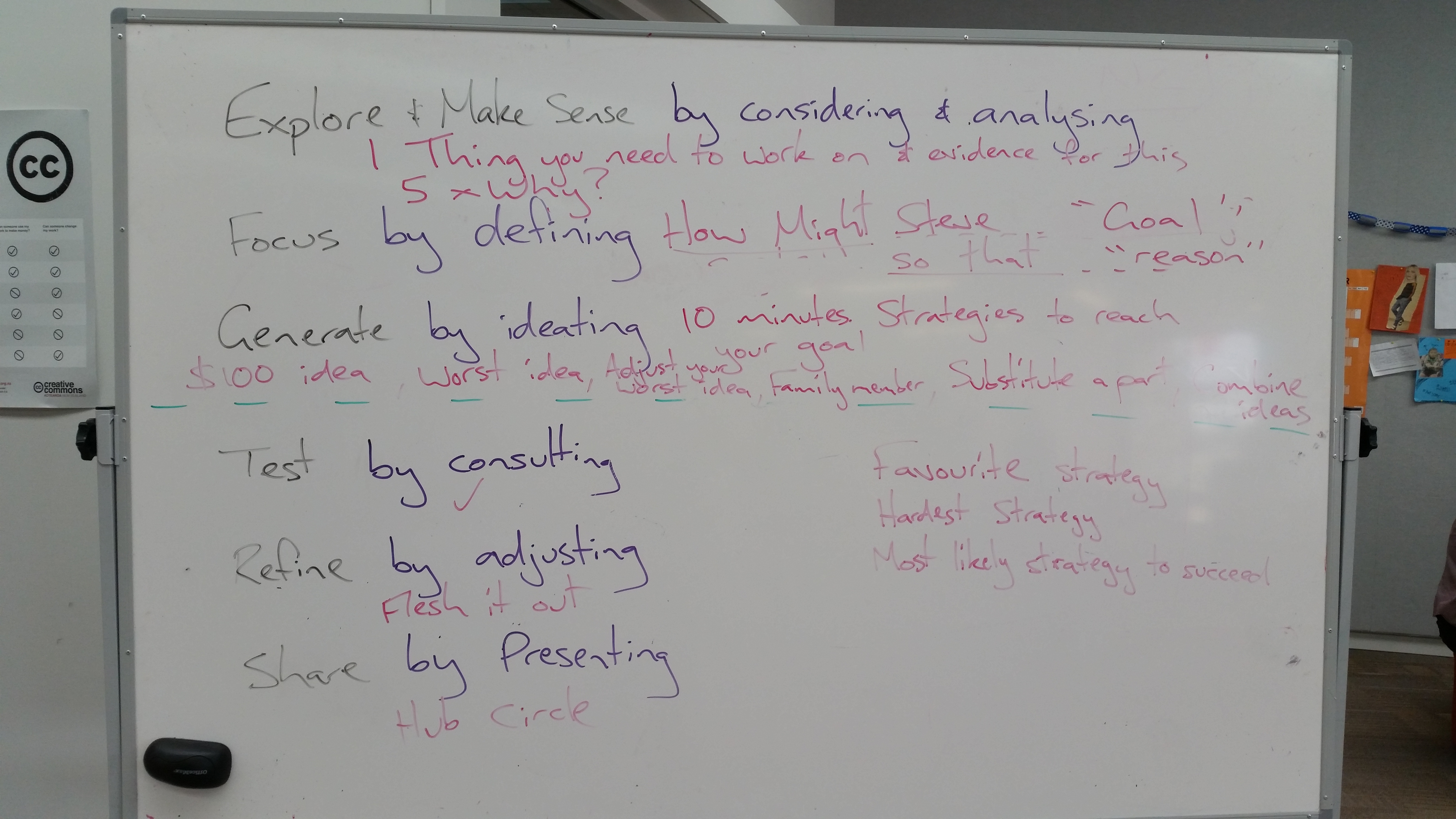
Hearing this from a normally quite cynical Year 10 boy was a great end to a session I ran yesterday. Our Taheretikitiki community is focusing on the Hobsonville Habit of Purposeful this week and it was my turn to run the community activity. Being early in the year, many of the Hubs have been developing goals for the year so the focus of the session was to develop strategies that would help them reach their goals.

Whiteboard notes that will make sense if you keep reading!

Whiteboard notes that will make sense if you keep reading!

The image above is the whiteboard notes from our Goal session and show the steps that we went through. The steps above the green line happened as a whole community (~79 students) and the last 3 steps were back in their hubs (groups of 11-12). Continue reading

What if PPTA does boycott EDUCANZ?

With legislation passed, it is now full steam ahead for EDUCANZ to replace the New Zealand Teachers Council. In response to this, the Post Primary Teachers Association (PPTA) is proposing a boycott of EDUCANZ and has asked all branches to run a ballot on this idea.

Why boycott? It is a flawed legislation. Teachers can no longer vote for representation on their own professional body, the aspirational code of ethics is being replaced with a patronising code of conduct and has a major focus on auditing teacher appraisal processes. Although, to be honest, I do see the positive side of auditing appraisal processes as well – how many of these are actually being done as a tick box affair as compared to operating in a way that helps us improve as professionals? Still a boycott would aim to build public pressure to force changes to the legislation.

We will still, however, all have to pay EDUCANZ to renew our teacher registration (and early signs are that fees will rise quite a bit) as it is illegal for us to be in the classroom without this. So effectively, if we boycott EDUCANZ we will give them money to complete their aims but remove any possibility of our voice having an influence in what that aim looks like in practice. Continue reading

MLP not MLE

This week I have been in Christchurch as part of our efellows programme. Our time was split between working on our research; provocations from Core staff such as Keryn Davis  (on power of play and student questions) and Derek Wenmoth (returning to the why and sharing books that are at the core of his beliefs to get us thinking of our core beliefs); and getting the chance to visit some schools in the area.

The schools that we were privileged to visit were Breens Intermediate and Te Pa o Rakaihautu. There were 2 really key points that I took from these visits: 1) seeing what it looks like when a shared vision is in action and 2) what MLE can look like in traditional classrooms. What they showed together was that modern learning environments is a complete misnomer, it is about modern learning practices. Continue reading