Day 10 of My Question Quest is reserved for a very small but powerful word – why?
Whether as a one word question or as the start of a longer question it holds enormous power for digging deep into a topic/issue/situation.
I hear this continuously at home from my 4 1/2 year old daughter (most recently into the minute details of Frozen). It has also held enormous power at work though as well – for my students, for me, from parents and for us as a whole staff.
One of the most powerful uses of this is when the question is asked 5 times in a row. Next time you (or your team) are making a decision, test your solution by asking why. Then after you answer that, ask why of that answer. Repeat until you have answered why 5 times. An awesome check for if the decision meets your vision and values!
Any major decision, inquiry, problem solving or design thinking situation should start from why. If not, you may be on the completely wrong track.
In teaching, if an e-tool will amplify the learning we are aiming for then it is worth using that tool. Today I started musing on the learning occurring when I use Design Thinking in my classes and where e-tools may have an amplification effect.
collaborate on Google Docs when generating and refining questions
a variety of tools for prototyping – Minecraft, house design sites, Google sites
a couple had website products they developed
Now these are all good uses of e-tools but I don’t feel they are unlocking an extra level of learning that other tools wouldn’t. I’m sure there is an opportunity here, I just can’t see it yet.
So, how might we use e-tools to amplify the already awesome learning that occurs during the Design Thinking process?
Right now, all around the world, many countries have school holidays. Thousands of teachers are spending part of these holidays attending education conferences. Getting inspired, sharing ideas and planning ways to transform their teaching to benefit the learners in their classes.
Fast forward 3 months and how many of these inspiring ideas have actually been implemented? At ICOT last year in Auckland I was inspired greatly by the ideas of Design Thinking from Ewan McIntosh. Yet, back in my school, very little occurred until I changed schools and had more agency to implement these ideas. I spoke to lots of teachers who enjoyed Ewan’s keynote and workshops but know many of these have not implemented the ideas yet at all.
What happens between being inspired at conferences and getting back to the classroom? Is it a crowd-based euphoria that disappears when we leave the conferences? Are the presenters too inspiring so we feel unable to emulate them? Why are ideas disappearing into a chasm to be lost for a year or 2 until we come across them again at another conference?
Do we need to set up critical friend pairings at conferences to check up on how implentation is going? Do we need a day back together 1 month later to discuss any misgivings we now have? Do we need help with pitching our ideas from conferences to senior leaders or influential colleagues?
How might we overcome the conference to classroom chasm?
I regularly try to develop my students’ ability to critique each other’s work. If collaborative learning is to work effectively, this ability to praise the right parts and challenge other ideas is critical for progress to be made. But, I am now wondering if we as adults are even modelling this for students?
Two tweets from people whose thinking I greatly admire have raised this point recently:
I have written previously about how empowering the New Zealand Curriculum is. There is however, the flip side of this where as schools adapt the NZC to fit their needs, do not take the chance to think critically and just make it fix what they have always done. The Education Review Office add to this as they congratulate different schools on their interpretation of the NZC even as they have interpreted it wildly different – from Grammar style schools doing things very traditionally to Hobsonville Point Secondary School redesigning things and everything else in between.
This to me, says the critique of the New Zealand Curriculum must first happen by looking at how it has been implemented. This means that teachers and schools must develop a culture of critique towards each others’ practice and external visitors must be able to join in that critique to remove the blinkers. Is there a gap between the espoused approach and the reality in classrooms (or open learning spaces as the case may be?).
My approach with students to critique has been along the method of Rose, Bud, Thorn
And I really find this is a great method for starting critique: It encourages you to find praise points, opportunities and to be critical. If any of these are missing then I don’t believe you have set your bias aside to truly critique.
Now, how about we get started on really critiquing each other for the benefit of the education system and especially for the benefit of our students futures.
One of the things I have been pondering lately is that if the ability to question is an important skill for students to develop, how do we recognise those students leading the way? Schools regularly reward students who can provide great answers, how could we reward those who provide great questions?
Could this be how we unlock and develop the creativity and innovation in students? Provide something to strive towards.
I’m imagining school prizegivings where alongside the top sports people and top subject prize winners there are awards for the students who asked such amazing questions that it unlocked a whole new area of inquiry for them or fellow students.
School honour boards replaced (or to give people something to hold onto, perhaps alongside) by Question hall of fames. In fact these don’t have to be school-wide, you could implement this in your class straight away. It’s something I’m planning to do next term!
Or, go along the path that Meghan Cureton from Mount Vernon Presbyterian School in Atlanta has and create an honours programme for those questioners and innovators. Their Innovation Diploma is an incredibly inspiring programme that I am already bugging our Principal to consider how we could adapt this for our school (and we don’t even have final year students for 3 1/2 years yet!).
How else could we reward questions and questioners in our schools?
I am just one of many who believe that the way forward for education is to have assessment that falls naturally out of the learning. This stops assessment being the driver and puts the important thing – the learning – back in focus.
So much of our education system here in NZ – and what I see, read and hear about from overseas – is happening the wrong way around. The importance of assessment in an outcomes based, quality assurance system that effectively pits schools against each other in competition means that we can’t make progress in getting the learning to be the driver.
I propose a shift. Lets stop talking about assessment and just start focusing on evidence of learning. In this fashion, the evidence should naturally fall out of the learning occurring. You may still choose to do this with a formal assessment. But now it’s an opt-in system rather than an opt-out system.
We all know the quality of learning that occurs when it can be focused on authentic tasks and this allows that to occur far more regularly. I wonder how long it will take for NZQA and other qualifications authorities to catch up?
Day 3 of my Questioning Quest belongs to a question from 2 of my Robotics students this afternoon.
They had been developing their code, testing the robot and making adjustments to improve its performance. Next thing I see their Tank Robot from Mind Kits no longer has its tracks on it as they did their next round of testing.
Distracted from helping another group I walked over asking what was going on. Their reply stopped me in my tracks:
We were just wondering what would happen if we took off the tracks
I laughed and told them what a perfect reply it was, threw them a few more questions: What happened? Why do you think that happened? etc and then left them to their ponderings.
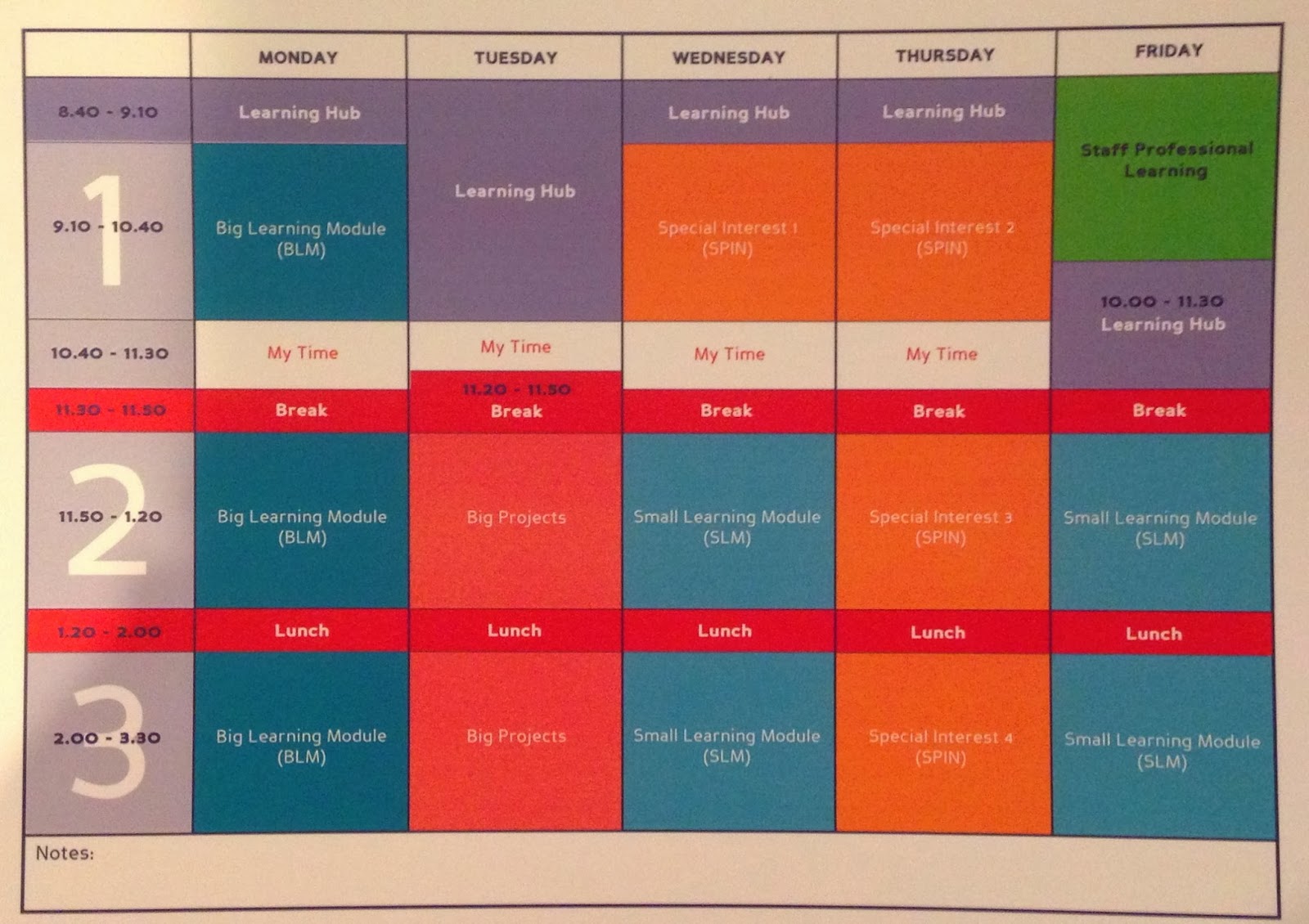
Our school structures are different than other NZ secondary schools. We have no subject departments, our courses are organised differently and our timetable looks different than most:
HPSS Timetable
A question we get often is how do we know that this is better than traditional school structures? My answer: we don’t YET. Our principal Maurie recently turned this around on the questioner by asking how he knew that his school’s system was working for that year’s students. Not last year’s students but the group in your classes right now. The fact is none of us can answer this without putting clones of students into 2 different systems so that you have a consistent base to start from.
We are collecting lots of data and talking regularly with students about evidencing their learning. Our students can tell you exactly what their curriculum coverage is like after 2 terms and have used this data to inform their Term 3 module choices. We are doing our best to start developing a tool so teachers, parents and students can easily check progress against the NZC and hope to have it up and running soon.
The next step I want to see stems from this awesome post by Bo Adams from Mount Vernon Presbyterian School. In it he outlines how they are using Learning Walks and Instructional Rounds to gather data and study their own school.
How do you know that your school structure is working for this year’s students?
This post is Day 2 of my Questioning Quest (even if I completely blew the 60 word target…)
Day 1 of my Questioning Quest, is a question constantly in my mind this year.
I truly believe the tension between personalisation and curriculum coverage can cause amazing creativity to occur in learning. Our vision of Personalised Learning must also ensure students have the required skills and understandings to succeed as seniors. To do so we are currently developing tools and checks to evaluate student coverage and progress amongst the high level of choice students have in their modules.
Many schools are investigating personalisation as a future focused curriculum or modern learning practice. How do you negotiate this tension?


 Steve Mouldey