
If you get included in the blogging meme: copy/paste the questions and instructions into your own blog then fill out your own answers. Share on twitter tagging 5 friends. Make sure you send your answers back to whoever tagged you too.
1. How did you attend the #Edchatnz Conference? (Face 2 Face, followed online or didn’t)
I was there for both days of the conference. On Friday I was teaching through most of the day so my involvement was mainly through inviting people in to be part of my Hub and my Apocalypse Now module. Saturday was far more of the conference experience for me.
2. How many others attended from your school or organisation?
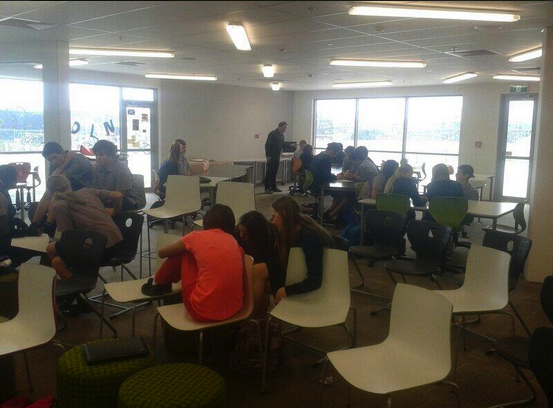
As we were hosting, our entire school was involved on the Friday – staff and students. On the Saturday there was still over half of our staff and a smattering of students attending (yes, students voluntarily at a conference on a Saturday!).
3. How many #Edchatnz challenges did you complete?
After setting the challenges for everyone I embarrassingly did not complete them all! I think it was 12 that I did complete. I missed the food sculpture, highest point, new technology (although did get to see the Ultimaker 2 3D printer in action that we have on order) and the dancing challenges. Am most disappointed about the dancing challenges as I often dance randomly throughout the day.
4. Who are 3 people that you connected with and what did you learn from them?
So many awesome face to face catch ups with incredible twitter colleagues that made the weekend feel a bit like Edu-Nerd party of the year! I especially enjoyed catching up with 2 ex student teachers Emma (@emmaotearoa) and Jess (@ikanarat). But have to give special mention here to 3 connections that reminded me of important things:
Reid (@ReidHns1) is brilliant. He laughs often and loudly and as someone with the nickname of Excited Puppy I love to find other teachers who are genuinely stoked in what they do.
Jonathan Finnerty (@FtFinnerty) was a student of mine in my first few years teaching and it is really cool to see him as a confident Geo teacher soaking up the inspiration. It was cool seeing him make his first tweet after the conference (that first risky step done) and I hope we see him connecting regularly online (no pressure now…)
Aaron Huggard (@MrHuggard) spent 3 hours of Friday sitting in my module with students. In speaking with him on Saturday he felt it was time spent well extremely well – if you want to experience a school, do so from a students perspective.
5. What session are you gutted that you missed?
Hard one, lots of awesome workshops I missed while teaching and presenting myself, didn’t get to see Pam Hook talk on SOLO but I would have loved to have been in Heather Eccles (@heccles01) session in support as she helped preservice teachers find the ways to connect with the awesome NZ education communities.
6. Who is one person that you would like to have taken to Edchatnz and what key thing would they have learned?
Would have loved to have taken Michael Harcourt (@harcoumich). He is an incredible teacher who has inspired me over the past 7 years. We used to work across a desk from each other and bounce ideas back and forth, he always had an article or book to suggest for me to read. When I moved back up to Auckland I turned to Twitter for that regular bouncing of ideas (we still skype but once or twice a term isn’t enough!) and so it would have been full circle to bring him to #edchatnz.
7. Is there a person you didn’t get to meet/chat with (F2F/online) that you wished you had? Why
Would loved to have chatted with Mark Buckland (@mjbuckland) face to face. Looking back through the tweets he was in a session I ran and in a couple of others I attended but somehow didn’t manage to connect. Will make sure this happens at ULearn!
8. What is the next book you are going to read and why?
Just started reading Creativity Inc today which I have been looking forward to for a while. If the new Ewan McIntosh book arrives it will be that next as I continue on my journey with Design Thinking. Otherwise Tait Coles’ Punk Learning that I got in the book swap at EdchatNZ conference, have read his blog for a while so interested to see what the book adds.
9. What is one thing you plan to do to continue the Education Revolution you learnt about at #Edchatnz?
I want to help encourage more people to connect not only on twitter but by sharing their learning through blogs. Mark Osborne’s keynote pointing out the depth of discussion available when we meet face to face can also happen through blogging and commenting. Would love to see more people start with this – this blogging meme will help!
10. Will you take a risk and hand your students a blank canvas?
Have become reasonably well known now for some of the risks that occur in my classes…A blank canvas is all good but I would also add a couple of constraints to the activity – this is what causes the creativity to occur.
Who do will I tag with this meme:
All people I’m not sure are blogging yet, hopefully this meme will extend their connection with #edchatnz:
@MrHuggard (ok one that already blogs but I’m still keen to see more of his ideas online!)

 Steve Mouldey