The Tribe Grows

This week we welcomed 9 more staff to the HPSS team. This means that apart from some part time language and music teachers we now have our full teaching staff for 2014 onboard. This first week was all about getting them up to speed with our vision and values and showing them the way we work.

Our introductions helped them get on board with our ways as we welcomed them with our ukeleles then gave 3 minute brutally honest accounts of ourselves. Later in the week,
Continue reading

Guerrilla Geography Day Past & Future: November 7th

Hope you all join in on this awesome day!

stevemouldey's avatarThe Guerrilla Geography Project 2014: Misplaced

Join us for #GuerrillaGeographyDay on November 7th as we explore how places have looked in the past and how they may look in the future

.

Taking part could involve you:

  • showing people what places used to look like in the past

  • transforming places to show what planned redevelopments will mean

  • creating imaginary futures for places

.

Here’s a list of actions that you could take:

1. Place images of the past in the places the images are of

2. Create artworks showing the past, present and possible future of that place and exhibit them somehow (see http://www.postcardsfromthefuture.co.uk/ for some inspiration for this)

3. Draw field sketches from the future of a site from one of your field trips or a place near your school so that the whole class can compare their sketches and discuss what they have imagined

4. Create a temporal map of your local area or…

View original post 74 more words

#GeoEdChat October 16th 2013: How can school grounds be used for teaching Geography?

Thinkpiece that I have written for tomorrow’s #GeoEdChat

stevemouldey's avatar#GeoEdChat

This post is a thinkpiece for #GeoEdChat to help people think of ways they have used or plan to use their school grounds to teach Geography. As Geographers we love working outside the classroom and believe in the power of this in aiding student learning. Along with the obvious examples of learning with field work, we often use the school grounds in creative ways.

Here are a few of the ways I have used the school grounds over the past 2 years:

  • Muriwai in chalkThe courtyard outside of our class was turned into our coastal environment and the students became the wave trains approaching the coast. In this way we were able to physically see the process of wave refraction occurring and discuss the reasons why to add depth to the annotated diagrams we drew in class.
  • Guerrilla LanguagesI have used Guerrilla Geography in many classes to get students thinking and provoking further thinking…

View original post 251 more words

Live Below The Line

From Monday to Friday this week I will be living on $2.25 a day to cover my food. This is part of Live Below the Line, an event to help raise awareness and money for the organisations working to end global poverty. I am supporting Oxfam NZ who do great work here in NZ as well as through the Pacific and SE Asia.

So I don’t clog up this blog with my progress, I will post my thoughts over the week on my Live Below the Line profile page. You can visit it here https://www.livebelowtheline.com/me/stevemouldey to see my progress and even donate to the cause if you would like to.

With this challenge going on this week, the ERO visit should be a cinch!

Lessons from Primary

Secondary teachers and schools have a lot to learn from their Primary counterparts.

Yesterday we spent the morning in 2 of our contributing schools. Yasmin, Sally, Jill and I went to Hobsonville Primary and Lisa, Kylee, Sarah and Megan went to Whenuapai. What we saw in each of these schools was great pedagogy and made us realise that our students for next year are going to be well prepared for what we are planning.

In fact, the biggest reflection point on yesterday was that what we have planned for Hobsonville Point Secondary School may be radical for Secondary but is not a big step different to what already exists in Primary schools. Continue reading

Future Learning

Networked Camping GroundI have recently finished reading Disciplining and drafting, or 21st century learning? by Rachel Bolstad and Jane Gilbert and found it incredibly timely as we are planning the learning design for our new school.

Some of the brief highlights of this book for me were:

  • “Knowledge is innovation. Its role is to generate new knowledge, to do things.”
  • The importance of developing systems level of understandings and higher order thinking skills
  • A need to shift focus from skills to dispositions

All of this aligns nicely with what we have been working towards so far at Hobsonville Point Secondary School. Continue reading

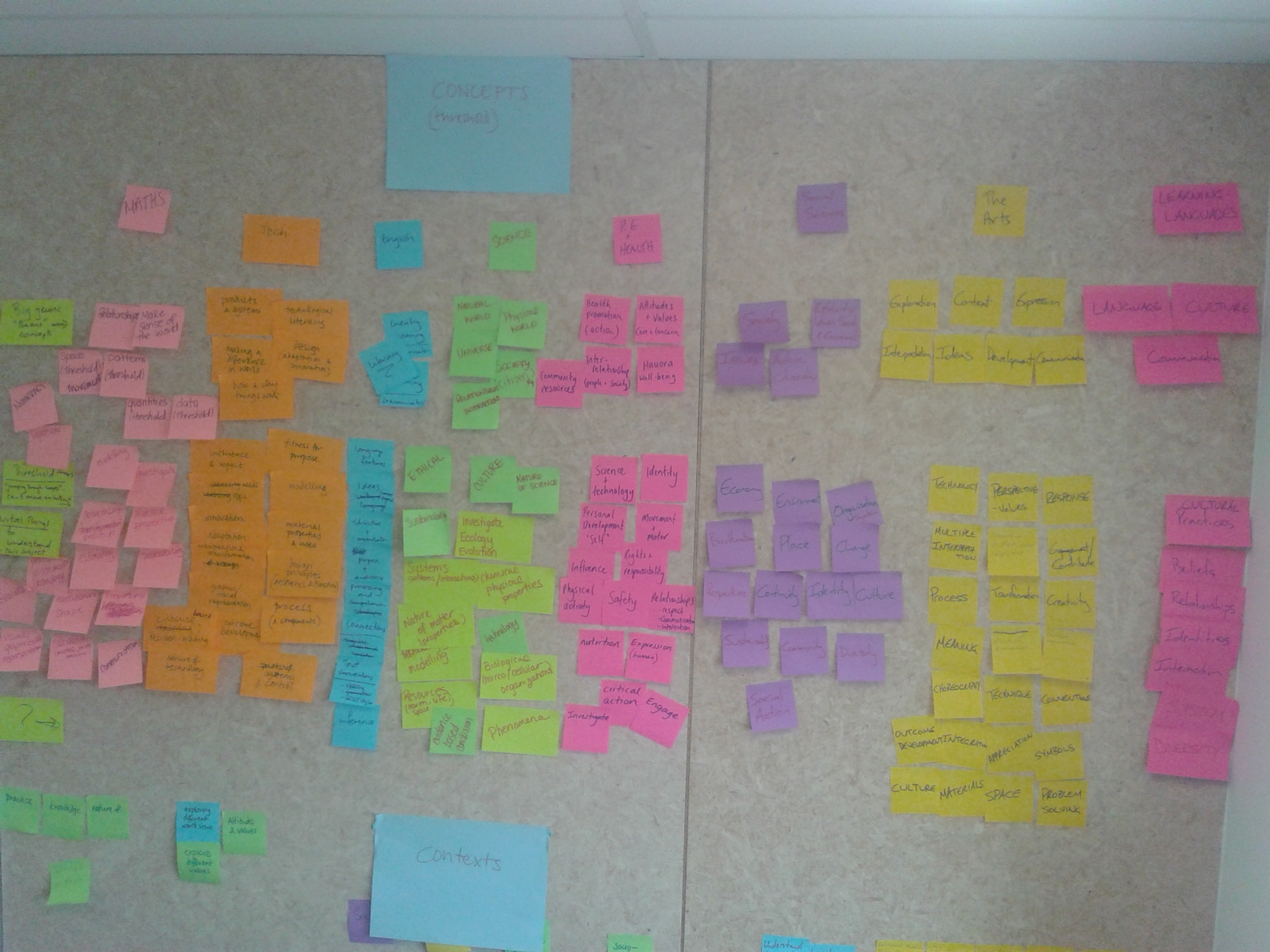
Exploring the Threshold Concepts of the NZC

Our aim Friday was to explore the core concepts of the New Zealand Curriculum to start focusing on what learning needs to occur next year.

The first major point of interest to emerge was how differently each learning area is organised within the curriculum. Many learning areas were organised by concepts but others focused on skills, dispositions or a mix of the three. Nevertheless we were able to help each other understand how to extract the threshold concepts from each of the areas.

By focusing on one learning area each and extracting the concepts from the curriculum, we soon got our initial impressions of the 8 Learning Areas. Then as a group we discussed what had been gathered during the first step. At the end of these discussions we had the core of what the learning area was aiming to achieve and the threshold concepts that learners need to develop to be able to achieve that core aim.

As an example of this Social Sciences has the core concepts of Society; Issues; Active Citizenship; and Relationship between Society and the Environment. The threshold concepts to reach this core were: Economy; Environment; Organisation and Systems; Biculturalism; Place; Change; Perspectives; Continuity; Identity; Culture; Sustainability; Community; Diversity; and Social Action.

This meant we ended the week with the threshold concepts of the entire NZC up on the wall of our “Hacking Cave”
NZC Threshold Concepts

NZC Threshold Concepts

There are some clear cross-overs that were noticed during the process and next week we will get to focus in on this aspect – where are the opportunities for authentic integration?


NZC and Design Thinking Part 2

While last week was about deconstruction and reconstruction of the New Zealand Curriculum, this week has been about gaining clarity in our process. The state of the table over the past 2 weeks in our “Curriculum Hacking Cave” shows this quite nicely.

20130911-151916.jpg
Continue reading