Unknown's avatar

About stevemouldey

Geographer, Educator, Pontificator

Kei te pehea koe?

This week is Te Wiki o Te Reo Maori (Maori Language Week) so my question today is honour of that.

Kei te pehea koe? means How are you?

Hopefully answered with Kei te pai (good) or even ka rawe ahau – I’m awesome!

To sign up for a Maori word of the day (or of the week) emailed to you see http://kupu.maori.nz/. They are also running free online sessions over skype teaching you how to speak te reo this week. See the session times (including time converter for those of overseas) here.


This post is Day rua tekau ma rua (22) of My Questioning Quest.

See you apopo (tomorrow)!

What If you reframed your school speech competition as a TEDx event?

We started Term 3 today with a Teacher Only Day, focusing on developing SOLO rubrics for our courses this term. Initially in Learning Area groups unpacking success criteria and writing rubrics so we have a common grounding across all courses and then in our cross-curricular teaching teams.

At one stage I found myself sitting listening in on the English teachers conversation about their rubric for Speaking which is a focus this term. The only previous time (not an English teacher so not part of my day to day focus!) I have heard teachers discussing this was to do with school speech competitions.

Then today’s question hit me: What If a school speech competition was reframed as a TEDx event?

Would it mean more entries? Does it change the criteria that teachers would use? Would students be more excited about it? Would they be more willing to share their passions and interests? Does it mean that you would invite more audience in? How does this change things? Would other students be more or less interested in watching the speeches?

No answers today, but lots of questions bounding around in my head!


This post is part of my Questioning Quest.

What If you had a teaching super power?

This post is definitely inspired by Science super hero Nano Girl (Michelle Dickinson). Growing up she always wanted to be a super hero and recently even completed a TEDx talk on how to Build a super hero out of yourself in 5 steps.

This afternoon I was talking with my partner and our 4 1/2 year old daughter about what super powers we would want to have (flying for my partner, ice powers such as Elsa in Frozen for my daughter and teleporting for me) when I realised my Question for Question Quest today:

What teaching super power would you like to have?

I think mine would be the power to give students the confidence to take that big learning risk.

I know that my learning risks get easier the more that I take so it would be great to give students the confidence to take those first few risks. For some students it might be standing up and sharing an idea, others it might be embracing the fact their idea might fail but trying anyway, others it could be about taking the lead role in their group. If they had the confidence to do this a few times, it could really help them take further calculated learning risks in future.

What would your teaching super power be?

Would it change if it was only for 1 day? 1 week? 1 month? A term? Permanent?


p.s. Bonus marks for those who work out how to make that super power happen. I am certainly aiming to give all my students the confidence to take learning risks this term! Will let you know how it goes.

How Might We create the learning experience of a conference more regularly?

Since my post on overcoming the conference to classroom chasm I have been wondering about maintaining the intense learning atmosphere of a conference when we are no longer all together.

Now, twitter is great for continually accessing information, ideas and resources but there is something all together different about the learning and networking that occurs at a conference. The Network for Learning Pond may be aiming to provide this for New Zealand teachers but at the moment is just a search engine, I look forward to seeing what the Communities function looks like when it is released.

Last year as we designed how Hobsonville Point Secondary School would operate we often talked about how it was exhausting even though we had no students. We realised it was because we were effectively living in a conference 24/7. We were given time to rethink education and were encouraged to read as much as possible (see here for readings that influenced us in our first term).

I still am privileged to work at HPSS and get access to amazing PD and rich learning conversations daily. We have, however, stopped sharing our reading as much as we used to and I miss those amazing conversations that developed as we shared and critiqued things we had read.

Then today, a great conversation erupted on twitter with @AKeenReader @chasingalyx @beechEdesignz @mattynicoll @shiftingthinkng @MissDtheTeacher and @mrs_hyde about sharing some of our edu-nerd reading we are doing. End outcome is that we are meeting/holding a workshop at the #EdChatNZ conference to organise a book chat to happen once a term where we read the same Edu book then meet up online (twitter or GHO) to discuss how we found it.

So now, I have my daily conversations, regular school PD, twitter chats, the odd Google Hangout (with long term critical friend Michael Harcourt or with new US critical friends Grant Lichtman, Bo Adams and Thomas Steele-Maley)  a new Edu-Nerd book club plus 2 conferences in this next term. Think I’m good for maintaining that conference feel, how are you going to keep the learning going?


This post is Day 19 of My Questioning Quest.

Is school discipline a breach of human rights?

This post is prompted by this article by Dan Haesler which covers the idea that removing students from a class (or more formally from school) may be a breach of students right to dignity and an education.

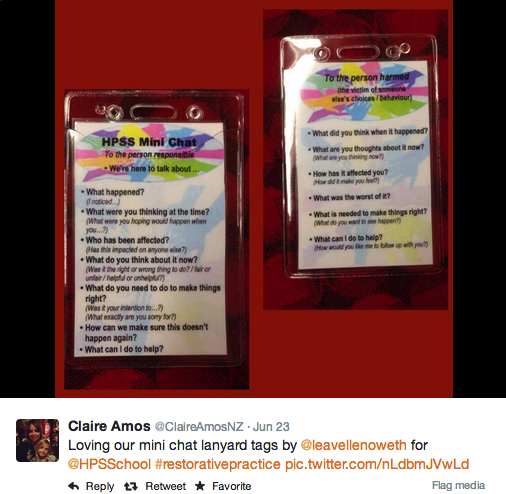
Our school is strong on restorative practices. This is lead by our Principal Maurie Abraham who regularly presents on implementing restorative practices and by one of our Deputy Principals Lea Vellenoweth who recently made us cards for our lanyards to help us remember the “Mini Chat” script:

Snip20140718_13

Our practices are reinforced (and challenged to improve) by Marg Thorsborne who is an inspiring pioneer and trainer of restorative practices. After her recent visit we have realised as a school that our next steps are to further educate our students and parents in what restorative practices really means.

I really like the “warm and demanding” approach that restorative practices promote. As a teacher my primary role is to help students learn. As Maurie pointed out late last year:

When students do not learn a new skill or concept we teach it to them again and again until they learn it. The same should be true of behaviour. If they don’t have the appropriate behaviour, it is our job to teach them the appropriate behaviour not just to mindlessly punish them.


This post is Day 18 of My Questioning Quest.


How Might We help students develop empathy for distant issues?

I see empathy as a key step in gaining a deeper understanding of issues and it is something I am trying to develop in students in my Social Studies (and Geography when I get back to teaching senior students again!) classes. When focusing on local issues or the local impacts of global issues, this is a step that is straight forward to implement. Exploring, observing, interviewing, listening etc to how it is affecting people. How do we do this effectively though for issues or case studies that don’t have such a local impact though?

Films can sensationalise and/or trivialise the impacts on people

Documentaries can be extremely biased

Role plays (thinking land mine victims by tied up legs etc.) are well meaning but do they really get students truly feeling what it is like – have seen plenty of giggles and laughter while doing this, definitely not how a true victim reacts.

Distance, time zones, language and cultural barriers can reduce our ability to interview, survey etc. whilst cost severely limits our ability to observe and explore the area.

In Geography and Social Studies we rightly study issues from all around the world. I want my students to be able to develop the deep understanding of these global case studies. How might we help students develop empathy for distant issues?


This post is Day 17 of my Questioning Quest.

What If money was no object for your classes this term?


It’s happened: you have an unlimited budget for your classes just for the next term. What do you change?

What experiences do you add in to make the most of this opportunity?

World class guest speakers?

Ultimate field trip?

Hire experts to work alongside your students – graphic designers to amp up the look of their work? Scientists and engineers to consult over whether their ideas could work? Programmers to teach students how to build that awesome website/app/game?

Write your ideas down now!

Image by Sean MacEntee

Image by Sean MacEntee

Now, of course, the unlimited budget is gone (sorry!). These ideas could still happen in some form couldn’t they?

How could you get some of those same experiences for your students? Virtual tours of the Smithsonian rather than flying there to see it? Skype or GHO experts instead of flying them in? Work out a partnership with a local business that gets you access to a graphic designer or engineer to bounce ideas with?

Your ultimate list without the money to truly do it could prove the creative catalyst to the ultimate classes still this term. Let me know how those classes now turn out!


This post is part of My Questioning Quest.

Lessons from Term 2

While playing with family over the first week of these holidays I have been reflecting back over last term. This reflection has led to me finding 5 key takeaways to remember in future.

1. Name the Elephant in the room

If you can name the issue/concern that is bugging you at the time it arises it allows your team to move forward together much quicker. An effective team has healthy working relationships and can deal with these situations, not get stuck on taking things personally.

2. Take the time to get students defining the problem

An extremely important step in problem solving is actually defining the right problem at the start. So often students are given the problem by the teacher. This term Pete McGhie and I really found out how powerful it is to get students defining the problem themselves. More time consuming but incredible learning ensued!

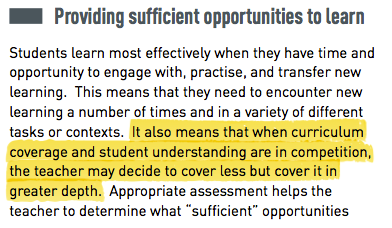
3. Teach less and teach it better

Page 34 New Zealand Curriculum

Page 34 New Zealand Curriculum

Continue reading

What If your latest off the wall idea actually succeeded?

So often when we have a light bulb moment / hare brained idea / I wonder if that could work type thought we immediately start thinking of the reasons why it won’t work. Next time you have one of these innovative ideas/thoughts why don’t you try thinking – What if this works?

If it comes off as you think it could, what would be the benefits? The outcomes? The changes it would cause?

If these outcomes/benefits/changes are positive then you can start thinking “How might we make this really happen then?”

By starting with the positives it opens up the possibilities, then by moving into the 2nd How Might We stage it reframes this possible into an actuality and it is just a case of getting the right people working on it to make it happen.

Wouldn’t it be great if instead of focusing on risks and barriers all the time we actually focused on the possibilities and started having more of these innovative ideas take off!

This post is Day 15 of my Questioning Quest.

Why does education have so many Chicken or Egg arguments?

Technology vs Paper and Pen

‘Traditional’ vs ‘Progressive’ pedagogies

Knowledge vs Skills

Quantitative vs Qualitative data

Cross-Curricular/Integrated vs Single Discipline/Subject

I’m not sure why so many of these dichotomous arguments emerge – every one of them to me is a case of both being appropriate depending on the context and circumstance. Any ideas on why these bi-polar arguments erupt continuously in education? Does it happen in other industries as well?

This post is Day 14 of my Question Quest.