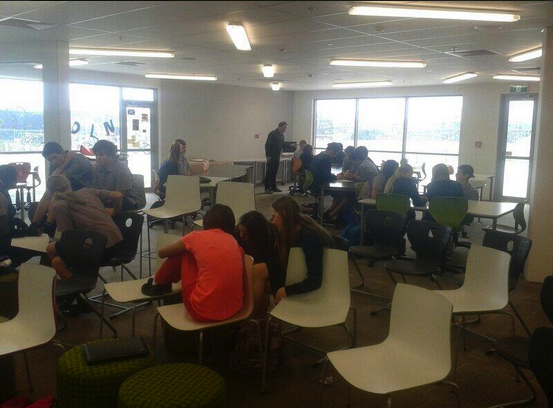
Last week I was lucky enough to be invited to Google Hangout into the awesome Fuse14 conference happening in Atlanta. After many twitter discussions with Grant Lichtman (author of The Falconer) and Meghan Cureton (Director of the Innovation Diploma at Mount Vernon Presbyterian Upper School, Atlanta) we decided it was time to chat ‘face to face’. The discussion also included Claire Amos and Karen Melhuish-Spencer here in NZ and ranged from the state of Design Thinking in our respective countries, how to grow student centred approaches through to the intersection of student passions and community needs. Watch the full video below:
Tag Archives: design thinking
Problem Finding and Student Ownership
This term I have been co-teaching a module with Pete McGhie that has had students focusing on our developing neighbourhood, Hobsonville Point, as a place. By investigating this place we have looked to find a need facing residents and then design a product that would improve their life here.
After initial lessons focusing on developing an understanding of how place, food and culture interact as concepts we went out to explore our surroundings:
After this exploration we focused on generating as many problems as possible that we saw in the neighbourhood.
Once we had brainstormed, shared and discussed the possible problems it was time to start defining the core problem as each group saw it. Continue reading
Changing Tack?
I have spent much of this term working and learning in the robotics lab with my students. This includes a Spin Module (90 minutes a week), Big Project (3 hours a week) and 2 My Times (flexitimes at 50 minutes each). Right now, I’m not thinking of being in here as much in future.
To meet the needs of our students who were interested in Robotics I got involved and have benefitted greatly from external support of those far more knowledgeable in this area than I am. But over the last week or so I have begun to question how much of my focus has been on our robotics areas. Because I do not have the skills and knowledge in this area, I am constantly needing to learn more and have found at times that I have not been able to help students as they struggle with certain aspects they are working on. Youtube, Instructables and Arduino tutorials have certainly helped but at times even then I have been flummoxed. So more time being spent (in school and out) learning and curating resources to help me and the students as we progress with their projects.
Of course, this then leads to the critical reflection points of am I adding value for these students? Continue reading
Improving Awesomeness in Iteration 2
Week 1 of Term 2 and Week 1 of #HackYrClass. I entered this term excited about the possibilities and also by the challenge set by Claire Amos to hack our classes. 2 aims for Hacking my classes came naturally – they were already my goals for my teaching this term: becoming student centred and increasing the use of design thinking.
Goal 1: Becoming more student centred
On Monday I sat in each of the Big Modules being taught in our school and filled out empathy maps for what it is like being a student at our school. Continue reading
Searching for Elegant Solutions
I recently read The Falconer by Grant Lichtman and thoroughly encourage each of you to do the same!
It really pulled some thought threads together for me and I found myself nodding away and tweeting quotes the whole way through the book. I had read the book to try and find ways to take Design Thinking from a process to a mindset and it has absolutely helped me to do this.
Pride and Excitement
Wow! Term 1 of HPSS is done. Awesome, Term 2 is close to starting!
This was the thought running through my head as I drove to work this morning. It sums up very succinctly what this reflection is about: how Term 1 has gone and where to next.
To start our last day of Term 1, Maurie asked us to briefly say 1 thing that we are most proud of 1 term in to HPSS. These were the thoughts that ran through my head:
- How well students can use our Learning Design Model in their learning
- The tweaks we have made to our modules for Term 2
- That I am still continuously searching for new ideas and ways to improve
- That the best is still to come
- The new skills I have learned with Robotics so I can enable students to follow their passions in this area
Catalysts for Curiosity and Creativity
This post is based on an Ignite talk I gave at the Learning at Schools Unconference at Sky City at the end of January.
Titled Catalysts for Curiosity and Creativity, in 5 minutes I briefly covered some suggestions for how teachers can enable students to unleash their creativity. Many of the ideas stem from 2 amazing books I read over summer: Can Computers Keep Secrets by Tom Barrett (from NoTosh) and Creative Confidence by Tom & David Kelley (of IDEO fame). I highly recommend reading both of these books!
When someone mentions curiosity to me, I think of:
- a sense of childlike wonder
- eyes wide open
- looking for new ideas to identify and explore
For me, I link this very closely with creativity. Yet so many people (like they do with Maths) say “I’m not creative.” Continue reading
Curiosity and Inspiration
Last night I bought, downloaded and read Can Computers Keep Secrets? How a Six-Year-Old’s Curiosity Could Change the World by Tom Barrett. Stemmed by all the questions his 6 year old son asks, Tom then delves into how we could maintain this natural curiosity that is with all youngsters but seems to disappear as we grow up.
I have long wondered at which point do we stop questioning the world like a 6 year old? When do we start to have more anxiety than curiosity?
Loc 176 of 489 on kindle Edition
These questions struck me as both an educator and a parent. Continue reading
Bias Towards Action

Elements of a Design Thinking Mindset from dSchool K12 Wiki
A bias towards action is the element of a design thinking mindset that resonates with me the most and what I see as really making this such a powerful pedagogical approach. Yet, the bias towards action is bizarrely an aspect that has seen some teachers question the appropriateness of design thinking as an approach for all learning areas. For me, the bias towards action is what makes this an authentic inquiry process rather than just another project producing a poster. Continue reading
A Culture of Prototyping
I have been thinking a lot lately about the diagram below which covers the elements of a Design Thinking Mindset. This is the first post in a series I hope to publish over the next fortnight covering how I see these developing at Hobsonville Point Secondary School.

Elements of a Design Thinking Mindset from dSchool K12 Wiki
A Culture of Prototyping can be quite scary for teachers (and particularly school leaders) to start developing. This is because it requires all members of the staff to have no fear of failure. Continue reading