Culture of Critique

This post follows from an Ignite talk I did this morning on a Culture of Critique and has been brewing for a while. My own reflections over the past 2 terms have now been influenced by my most recent read – Creativity Inc by Ed Catmull, the Head of Disney Pixar.

We have a mantra at HPSS that we use regularly – Warm and Demanding (see this earlier post about Warm and Demanding). I feel we are getting the Warm great, the demanding happens from time to time but I question whether we utilise the warm AND demanding enough in a way that pushes us forward as a school.

For me, this links with an analogy I loved from Creativity Inc: imagine an old heavy suitcase whose well-worn handles are hanging by threads. Continue reading

Active Citizenship

This term on Mondays I teach a Big Module called Take Action with Bryce and Martin. We have joined our subject areas of Social Sciences, PE/Health and Technology around the ideas each area has on taking action to influence society. Monday this week was the best day’s teaching I have ever had on developing students’ citizenship. There were aspects of digital citizenship, elections and other forms of taking action on issues in society. Continue reading

Prototypes, Errors and Focus

Interesting day yesterday: figured out a way to make a prototype work, developed a 2nd prototype, discarded both prototypes for a list of questions.

We are currently evaluating and reviewing our module structures to check how they are working for student learning. Staff have completed an evaluation of these structures, the student evaluation survey closes today and as Specialised Learning Leaders we have added our thoughts and concerns. Continue reading

All is well, or is it?

I was worried how last week would go. How could I possibly keep up the excited puppy heights of hosting the Geography Awareness Week TeachMeetNZ and being at the inaugural EdChatNZ conference?

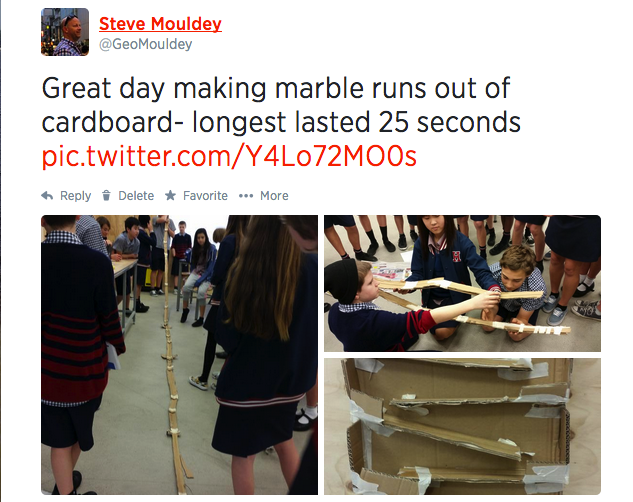
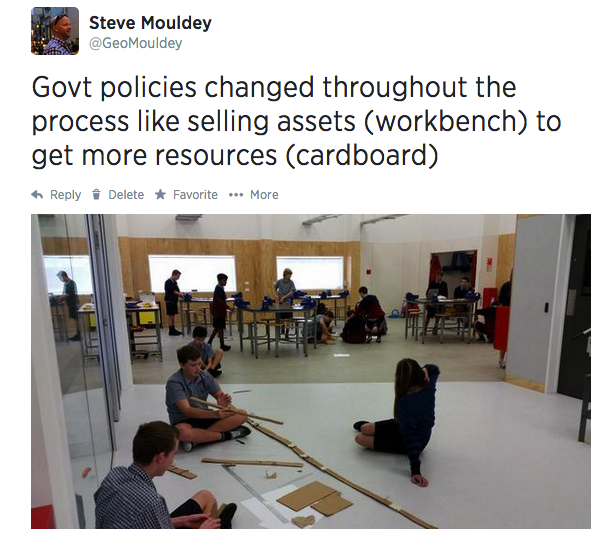
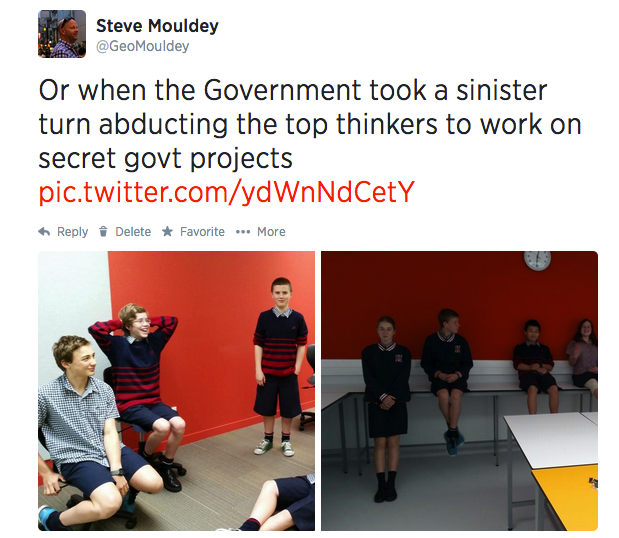
The Monday following EdchatNZ conference saw me spend the day in the Take Action big module I am co-teaching with Bryce and Martin. I spent 2 of our blocks helping Martin in the workshop as students constructed marble runs while their groups were affected by changes in government policies.

Snip20140817_20

Snip20140817_21

Snip20140817_22

Students also had similar experiences with Bryce as they played Volleyball with Government policies affecting the rules for each team. The final block focused in on actions we can take as citizens other than voting and brainstorming issues of interest to the students. Continue reading

What if you could ask anything of a teacher at HPSS?

A gimme for my birthday!

This week Hobsonville Point Secondary School is playing host to the inaugural #EdChatNZ conference. Amongst all the amazing workshops, Ros Maceachern (@rosmaceachern) is giving a presentation on the way we operate at HPSS. What we (particularly Ros) need to know is what you would like to hear about?

Please contact Ros either via twitter or email her any questions or topics you would like to hear about at ros.macheachern@hobsonvillepoint.school.nz. Or of course you can comment here and I can pass it on to her.


This is a gimme post for my Questioning Quest.

How Might We purposefully develop students’ learning dispositions?

At Hobsonville Point Secondary School we focus on developing both academic and personal excellence. This mirrors recent changes globally in education where learning dispositions are becoming a more important focus for many schools.

So far we have been focusing on doing this in our Learning Hubs (our version of an advisory system). But there are also moves amongst some staff to have these being developed within the learning modules as well. This makes sense. I can think of last term where I focused on developing students curiosity as well as increasing their skill level within my robotics class.

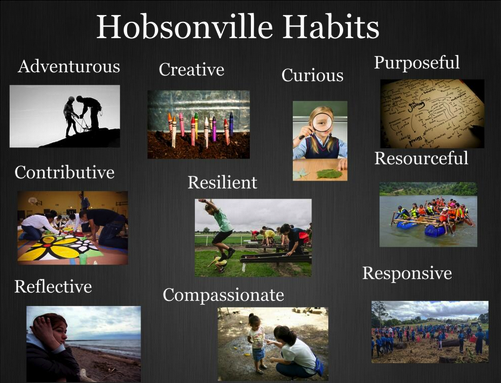
We have 10 learning dispositions we focus on called the Hobsonville Habits:

Hobsonville Habits courtesy of Sally Hart

Hobsonville Habits courtesy of Sally Hart

This term we are focusing on making the learning more explicit for students. They have eportfolios set up to track their own progress and need teachers to help advise them to tag their progress accordingly – learning areas, Habits, phase of our Learning Design Model etc.

As an attempt to make the Habits explicit, our Learning Community (Taheretikitiki with the other coaches being Megan, Lea, Bryce and Danielle) are taking on a Hobsonville Habit Challenge. Each week this term we are challenging each other to share how they are using 1 of the Habits.

  • Week 1: Purposeful
  • Week 2: Refective
  • Week 3: Curious
  • Week 4: Resourceful
  • Week 5: Contributive
  • Week 6: Adventurous
  • Week 7: Creative
  • Week 8: Resilient
  • Week 9: Compassionate
  • Week 10: Responsive

Students and teachers are going to share on a wall in our area plus on social media using #hobbyhabitschallenge how they (or someone else they notice) are using that habit.

My modules really kick into gear this week so I have been purposeful in planning to develop dispositions amongst the lesson plans (helped in massive amounts by the Key Competencies for the Future book I finished reading last week!). Will let you know how this develops over the term to see if I get better at doing this (already seems better in my head at least than just doing a tick box “of course I taught that Key Competency” type approach I have done in the past!). For a great example of how this can work see the section in Sally’s post on how her and Lisa purposefully focused on 4 habits for their Thought in Sport module.

How do you develop learning dispositions with your students?


This post is Day 27 of My Questioning Quest

What if we all saw ourselves as transitional educators?

What if we all took on the challenge to see ourselves as “transitional educators” (or, the term we’ve used in this chapter, “future-building educators”)? What if we all saw our professional responsibility as being not only about supporting young people to plan for and create their futures, but supporting the whole system to move towards a new configuration that is more likely to build a better future for our selves and our environment? What might we do differently in our day-to-day work, or over the scale of a week, year, or a phase of our lives or careers?

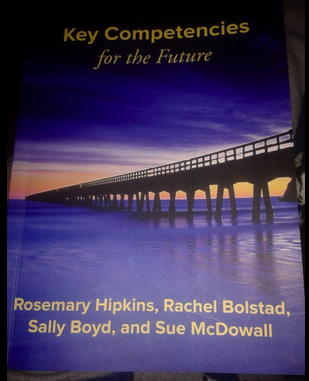
(pp 132-133 Key Competencies for the Future by Hipkins, Bolstad, Boyd and McDowall)

An inspiring call to arms towards the end of this great book (full review coming soon). I feel this is what we are trying to become at Hobsonville Point Secondary School. What if we really all took on this challenge? What if this was nation-wide? Global even?

This post is Day 24 of My Question Quest.

How Might We encourage young people to stay hopeful, without sweeping hard questions under the carpet?

Snip20140723_20

I am currently reading Key Competencies for the Future by Rosemary Hipkins, Rachel Bolstad, Sally Boyd and Sue McDowall and have found it incredibly inspiring. At the end of a chapter about making meaning across the different disciplines, they pose 6 questions for educators to discuss. One of these questions is the (very slightly reworded) question for today:

How Might We encourage young people to stay hopeful, without sweeping hard questions under the carpet?

To me, this is a key challenge as we strive to make learning more authentic. So many of the issues facing the world at the moment and into the future can be such powerful learning prompts but so overwhelming.

As a social scientist I completely believe we have to embrace controversy and complexity in the classroom and have always striven to do so. This term I am co-teaching a module with Danielle Myburgh called Apocalypse Now which is Continue reading

How Might We create the learning experience of a conference more regularly?

Since my post on overcoming the conference to classroom chasm I have been wondering about maintaining the intense learning atmosphere of a conference when we are no longer all together.

Now, twitter is great for continually accessing information, ideas and resources but there is something all together different about the learning and networking that occurs at a conference. The Network for Learning Pond may be aiming to provide this for New Zealand teachers but at the moment is just a search engine, I look forward to seeing what the Communities function looks like when it is released.

Last year as we designed how Hobsonville Point Secondary School would operate we often talked about how it was exhausting even though we had no students. We realised it was because we were effectively living in a conference 24/7. We were given time to rethink education and were encouraged to read as much as possible (see here for readings that influenced us in our first term).

I still am privileged to work at HPSS and get access to amazing PD and rich learning conversations daily. We have, however, stopped sharing our reading as much as we used to and I miss those amazing conversations that developed as we shared and critiqued things we had read.

Then today, a great conversation erupted on twitter with @AKeenReader @chasingalyx @beechEdesignz @mattynicoll @shiftingthinkng @MissDtheTeacher and @mrs_hyde about sharing some of our edu-nerd reading we are doing. End outcome is that we are meeting/holding a workshop at the #EdChatNZ conference to organise a book chat to happen once a term where we read the same Edu book then meet up online (twitter or GHO) to discuss how we found it.

So now, I have my daily conversations, regular school PD, twitter chats, the odd Google Hangout (with long term critical friend Michael Harcourt or with new US critical friends Grant Lichtman, Bo Adams and Thomas Steele-Maley)  a new Edu-Nerd book club plus 2 conferences in this next term. Think I’m good for maintaining that conference feel, how are you going to keep the learning going?


This post is Day 19 of My Questioning Quest.

Is school discipline a breach of human rights?

This post is prompted by this article by Dan Haesler which covers the idea that removing students from a class (or more formally from school) may be a breach of students right to dignity and an education.

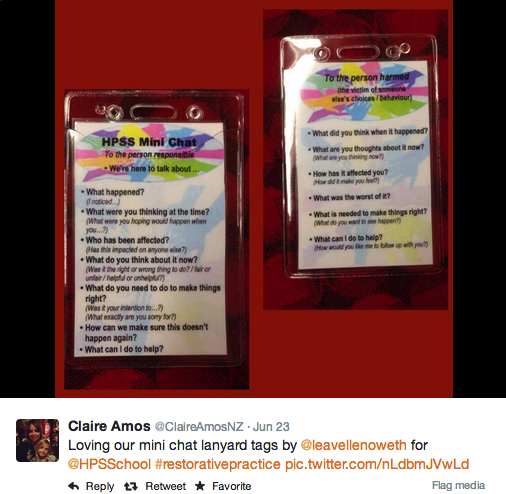
Our school is strong on restorative practices. This is lead by our Principal Maurie Abraham who regularly presents on implementing restorative practices and by one of our Deputy Principals Lea Vellenoweth who recently made us cards for our lanyards to help us remember the “Mini Chat” script:

Snip20140718_13

Our practices are reinforced (and challenged to improve) by Marg Thorsborne who is an inspiring pioneer and trainer of restorative practices. After her recent visit we have realised as a school that our next steps are to further educate our students and parents in what restorative practices really means.

I really like the “warm and demanding” approach that restorative practices promote. As a teacher my primary role is to help students learn. As Maurie pointed out late last year:

When students do not learn a new skill or concept we teach it to them again and again until they learn it. The same should be true of behaviour. If they don’t have the appropriate behaviour, it is our job to teach them the appropriate behaviour not just to mindlessly punish them.


This post is Day 18 of My Questioning Quest.