Provoking Thoughts Every Week

My role at Hobsonville Point Secondary School is called Specialised Learning Leader. Acknowledging that to most others outside our school, this title means nothing: the crux of the role is around curriculum and learning design. One of the tasks I have had in this role this year is to provoke staff thoughts around learning design each week. I have done this through sharing a weekly provocation: a reading, article, video that could prompt thoughts around designing better learning experiences for our students at HPSS.

Image courtesy of Brian Talbot

Image courtesy of Brian Talbot

Any of you that regularly read this blog or follow me on twitter will know that I read voraciously. This is a big part of my growth as an educator and this weekly provocation is aimed at encouraging all staff to grow by regularly reading and considering the implications on our practices.

The readings are shared via email each week and paper copies are placed on tables in the staff room. This means that we are providing for those happy to read on their laptops and for those who prefer hard copy to read or who may pick it up to read while having lunch or a coffee.

Initially starting with any article that linked towards our school’s vision for teaching and learning, we soon adjusted it to fit with our current SLL team focus: Continue reading
Leading With Design Thinking

I spent a great deal of time at the end of Term 2 focusing my thoughts on how Design Thinking applies to educational leadership. This is something that we have been doing at Hobsonville Point Secondary School, but a couple of presentations I did in Term 2 meant that I had to clarify my thoughts about what it really meant to lead with Design Thinking.

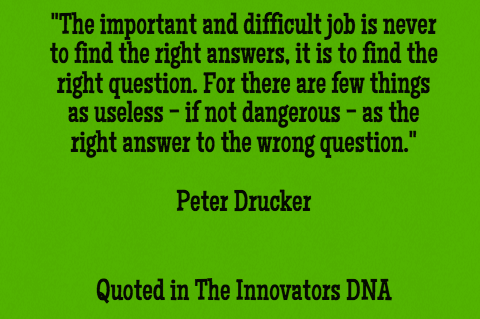
For me, part of why I find Design Thinking an effective approach to school leadership is captured in this quote:

Design Thinking is a Human-centred process (or mindset) for dealing with open, complex problems. Now, to me, ‘open, complex problems’ sums up education in a nutshell. And the focus on empathy that a Design Thinking approach brings is ideal for focusing on the right question – the cause of issues arising rather than the symptoms. Continue reading

NZ Education’s Biggest PD Need

MLE, 1:1 BYOD programmes, Dispositional Curriculums, new Timetables, new SMS & LMS, GAFE or Office365. All ‘new’ ideas coming into schools across New Zealand and all ideas being slammed by people because of the poor implementation.

Speak to teachers at conferences or scroll through any social media and read teachers comments. You will find teachers questioning or slamming ideas because of how they have been implemented at their school or a friend’s/local school. Teachers absolutely have the right to challenge the ideas being implemented but so many of these challenges are not of the ideas themselves, it is actually about the way they are being implemented.

Not enough PD or time spent helping staff upskill and see how they can best use *insert new idea here* is not a fault of the idea, it is a fault of the change management. Continue reading

What is the Essence of Your School?

Thanks Jo for this image from #EdJourney by Grant Lichtman

Thanks Jo for this image from #EdJourney by Grant Lichtman

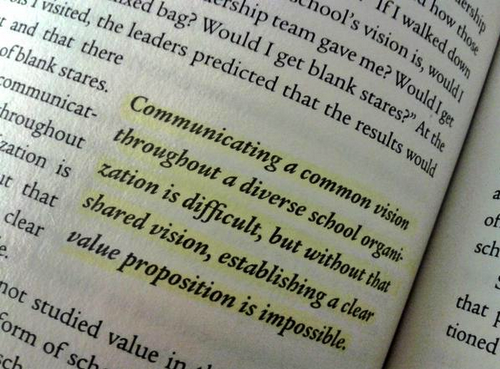
In #EdJourney, Grant Lichtman discusses schools’ value proposition. That is, what your school offers compared to other schools. Each school sets out their vision – implemented to different levels by different schools, some completely through all staff members, some just believed by Senior Leadership. The Value Proposition, as I understand it, is about what you actually do compared to what you say you will do (much like Espoused Theory vs Theory in Use by Chris Argyris). It essentially says that the practices of a school tells their community they really value. If we asked parents what their son or daughter gains by going to your school rather than the one down the road, this is the Value Proposition.

This reminded me of a challenge from Ewan McIntosh at the end of last year to capture the essence of what our school was all about in just 1 sentence. Continue reading

#EdJourney Part 1

Snip20150128_1   I recently finished reading a wonderful book by Grant Lichtman called #EdJourney. This book is the result of an 89 day trip in which he visited 64 schools and interviewed over 600 people on educational innovation and the future of schools. Part One of the book is on roadblocks to change and innovation in schools and then gives examples of how schools he visited have overcome these. The four major obstacles found were:

  • Time (the most common)
  • People (risk, fear and growth mindset)
  • Leadership
  • Structure

Each of these are discussed in a chapter and also gives examples of how schools have overcome each of these. Continue reading