While playing with family over the first week of these holidays I have been reflecting back over last term. This reflection has led to me finding 5 key takeaways to remember in future.
1. Name the Elephant in the room
If you can name the issue/concern that is bugging you at the time it arises it allows your team to move forward together much quicker. An effective team has healthy working relationships and can deal with these situations, not get stuck on taking things personally.
2. Take the time to get students defining the problem
An extremely important step in problem solving is actually defining the right problem at the start. So often students are given the problem by the teacher. This term Pete McGhie and I really found out how powerful it is to get students defining the problem themselves. More time consuming but incredible learning ensued!
I regularly try to develop my students’ ability to critique each other’s work. If collaborative learning is to work effectively, this ability to praise the right parts and challenge other ideas is critical for progress to be made. But, I am now wondering if we as adults are even modelling this for students?
Two tweets from people whose thinking I greatly admire have raised this point recently:
I have written previously about how empowering the New Zealand Curriculum is. There is however, the flip side of this where as schools adapt the NZC to fit their needs, do not take the chance to think critically and just make it fix what they have always done. The Education Review Office add to this as they congratulate different schools on their interpretation of the NZC even as they have interpreted it wildly different – from Grammar style schools doing things very traditionally to Hobsonville Point Secondary School redesigning things and everything else in between.
This to me, says the critique of the New Zealand Curriculum must first happen by looking at how it has been implemented. This means that teachers and schools must develop a culture of critique towards each others’ practice and external visitors must be able to join in that critique to remove the blinkers. Is there a gap between the espoused approach and the reality in classrooms (or open learning spaces as the case may be?).
My approach with students to critique has been along the method of Rose, Bud, Thorn
And I really find this is a great method for starting critique: It encourages you to find praise points, opportunities and to be critical. If any of these are missing then I don’t believe you have set your bias aside to truly critique.
Now, how about we get started on really critiquing each other for the benefit of the education system and especially for the benefit of our students futures.
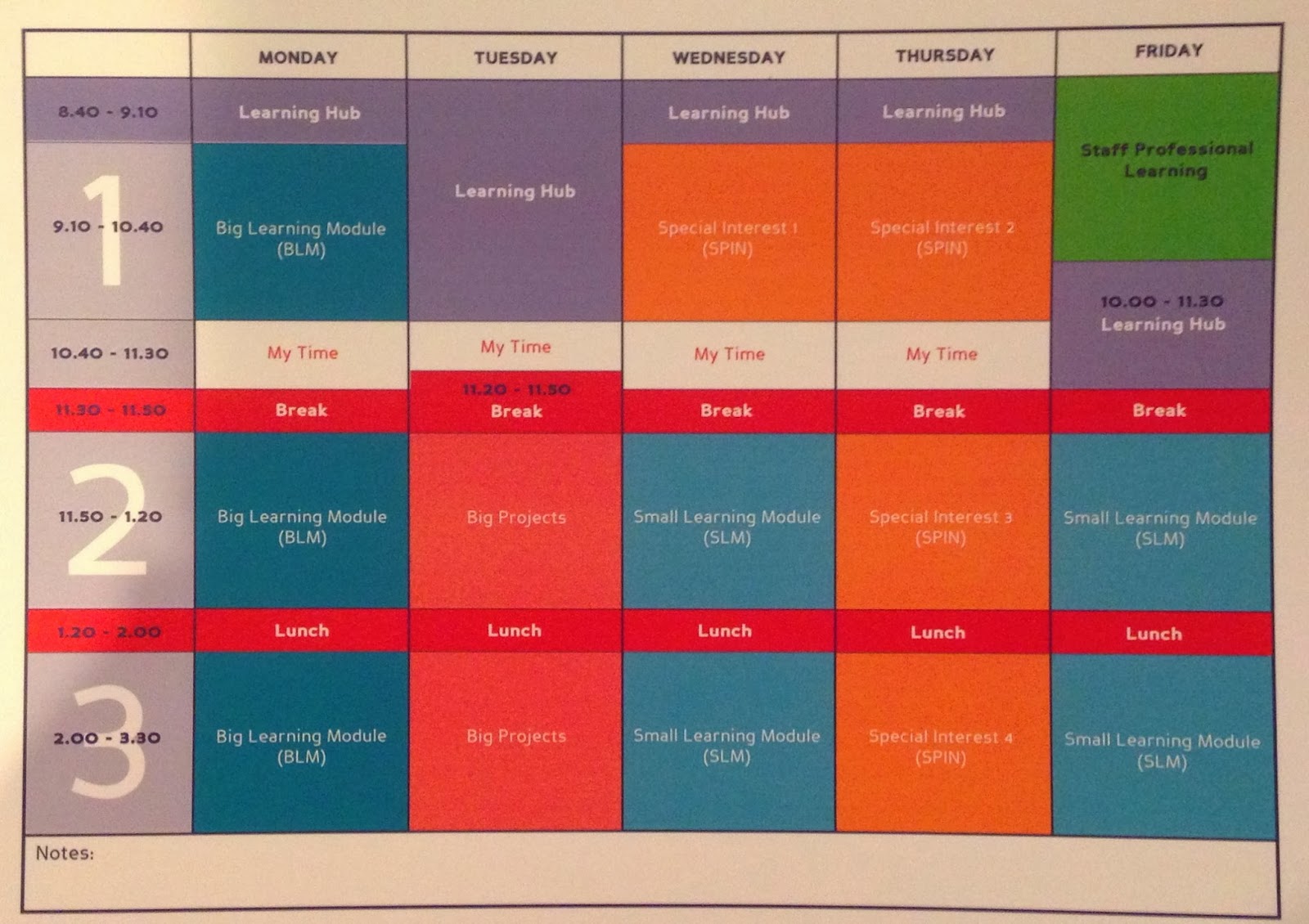
Our school structures are different than other NZ secondary schools. We have no subject departments, our courses are organised differently and our timetable looks different than most:
HPSS Timetable
A question we get often is how do we know that this is better than traditional school structures? My answer: we don’t YET. Our principal Maurie recently turned this around on the questioner by asking how he knew that his school’s system was working for that year’s students. Not last year’s students but the group in your classes right now. The fact is none of us can answer this without putting clones of students into 2 different systems so that you have a consistent base to start from.
We are collecting lots of data and talking regularly with students about evidencing their learning. Our students can tell you exactly what their curriculum coverage is like after 2 terms and have used this data to inform their Term 3 module choices. We are doing our best to start developing a tool so teachers, parents and students can easily check progress against the NZC and hope to have it up and running soon.
The next step I want to see stems from this awesome post by Bo Adams from Mount Vernon Presbyterian School. In it he outlines how they are using Learning Walks and Instructional Rounds to gather data and study their own school.
How do you know that your school structure is working for this year’s students?
This post is Day 2 of my Questioning Quest (even if I completely blew the 60 word target…)
Last week I was lucky enough to be invited to Google Hangout into the awesome Fuse14 conference happening in Atlanta. After many twitter discussions with Grant Lichtman (author of The Falconer) and Meghan Cureton (Director of the Innovation Diploma at Mount Vernon Presbyterian Upper School, Atlanta) we decided it was time to chat ‘face to face’. The discussion also included Claire Amos and Karen Melhuish-Spencer here in NZ and ranged from the state of Design Thinking in our respective countries, how to grow student centred approaches through to the intersection of student passions and community needs. Watch the full video below:
This term I have been co-teaching a module with Pete McGhie that has had students focusing on our developing neighbourhood, Hobsonville Point, as a place. By investigating this place we have looked to find a need facing residents and then design a product that would improve their life here.
After initial lessons focusing on developing an understanding of how place, food and culture interact as concepts we went out to explore our surroundings:
After this exploration we focused on generating as many problems as possible that we saw in the neighbourhood.
Once we had brainstormed, shared and discussed the possible problems it was time to start defining the core problem as each group saw it. Continue reading →
Earlier this week I had a mini-mental tantrum to do with my struggles teaching robotics. I pride myself on having a Growth Mindset but it absolutely disappeared on me as I thought “that’s it, next term I’m moving back to teaching the stuff that I know really well and that is my passion, not theirs (the students).” But after letting my tantrum go I was able to reflect and move forward with teaching robotics in a more effective way.
This whole episode (and how quickly it happened) reminded of a visual metaphor (I think that’s the right thing – I may be about to be slayed by the English teachers out there!) I thought of a couple of weeks ago when having a critical friend talk with Maurie. Continue reading →
Will attempt to update this post as we go throughout the day today. My first attempt at “Live Blogging” but will be more a regularly updated blog today.
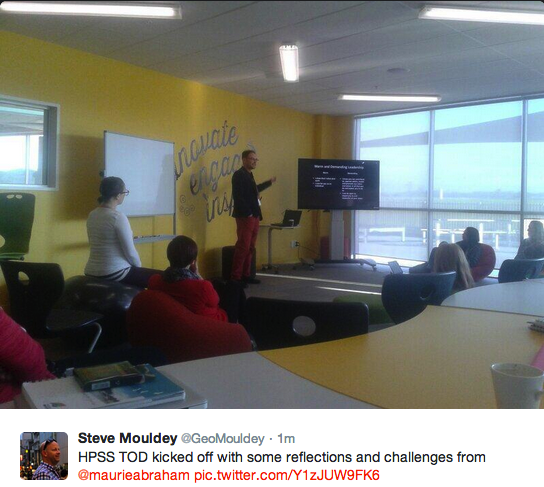
Maurie started us off by sharing some of his recent reflections:
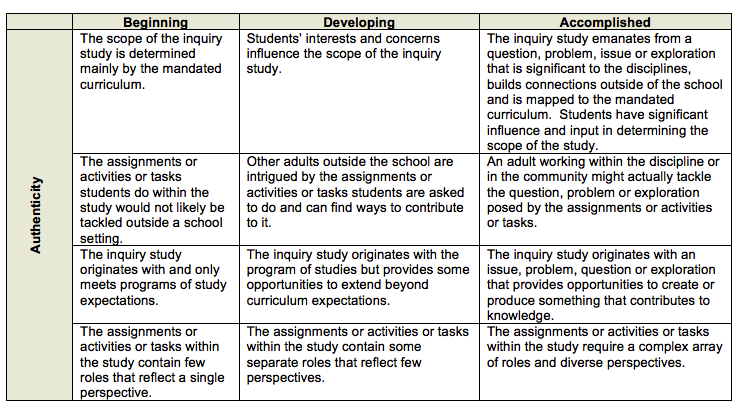
Another full on week at HPSS where I really focused on continuing to make sure the learning was authentic. This was the next step up as I try to continually improve the learning occurring and much of what happened in the week was due to what had occurred the previous week.
The Galileo Educational Network have an awesome inquiry rubric that I regularly refer to. This image below is of the section on Authenticity that I have looked back on whilst reflecting on the weekend:
Week 1 of Term 2 and Week 1 of #HackYrClass. I entered this term excited about the possibilities and also by the challenge set by Claire Amos to hack our classes. 2 aims for Hacking my classes came naturally – they were already my goals for my teaching this term: becoming student centred and increasing the use of design thinking.
Goal 1: Becoming more student centred
On Monday I sat in each of the Big Modules being taught in our school and filled out empathy maps for what it is like being a student at our school. Continue reading →
Entering this term I had set myself the goal of improving in my role as a Learning Coach as I felt this was the area of of teaching I was least proud of in Term 1. Our Learning Hubs at Hobsonville Point Secondary School are a version of Learning Advisories as seen at Big Picture Schools and we see our students every day ranging in time from 30 minutes to 2 hours.
In these hubs we are developing students’ Hobsonville Habits (our learning dispositions) their metacognition (which we are using Hermann’s Brain as a focus on this) their hauora (wellbeing) and also being an active advocate for students in their learning. I had done all of these things well in Term 1 but thought that I could make this more powerful for them by personalising our activities to be more meaningful for these specific students.
The activity I describe here took place on Tuesday morning when we spent 2 hours together and is based heavily on an idea from The Falconer by Grant Lichtman (see my full reflection on this book here). Continue reading →




 Steve Mouldey